Thursday, August 31, 2023

Here’s What We Know About the Email Aliases Joe Biden Used While Vice President

President Biden And VP Harris Meet With 60th Anniversary Of The March On Washington Organizers And Members Of The King Family

When Joe Biden was Vice President, he used multiple email addresses. While members of the public might have guessed they could reach Barack Obama’s running mate at, say, joe.biden@whitehouse.gov, he often used email accounts under aliases like Robert Peters and JRB Ware. Biden was following a common practice among senior government officials hoping to thwart hackers, as well as prevent spammers from guessing their address and clogging their inbox, according to a White House official.

[time-brightcove not-tgx=”true”]

Now House Republicans, who have spent months trying and failing to show that Joe Biden was involved in his son Hunter Biden’s overseas business dealings, want the National Archives to hand over more than 5,000 messages from Biden’s vice presidency that relate to those email addresses, thinking those messages might reveal something new.

On Aug. 17, Rep. James Comer, the Kentucky Republican who chairs the House Oversight Committee, wrote to the head of the National Archives, Colleen Shogan, to ask her to give the committee any documents where Joe Biden corresponded using the names Robert Peters, Robin Ware and JRB Ware. In that letter, Comer said that the committee wants the information to “craft legislative solutions aimed at deficiencies it has identified in the current legal framework regarding ethics laws and disclosure of financial interests related to the immediate family members of Vice Presidents and Presidents.”

Comer’s demands pile on to a two-year-old request from Republican Senators Chuck Grassley and Ron Johnson asking the National Archives for communications where Biden used such aliases. 

In addition, a conservative legal group, the Southeastern Legal Foundation, which filed a Freedom of Information Request for such emails in 2022, sued the National Archives on Aug. 28, for disclosure of the records. That suit in particular has sparked intense speculation in conservative circles about Biden’s alias email accounts.

Why did Joe Biden use an alias to send emails when he was Vice President?

Joe Biden used Gmail addresses with the name “robinware456” and “JRBWare” during his time as Vice President. He also used a government-issued pci.gov account with the name “Robert.L.Peters”. The pci.gov domain has been used for emails of officials working in the executive office of the president. The National Archives has retained thousands of emails connected to those accounts in its records from Biden’s time as Vice President.

A White House official said that Biden used these alternate names for his email accounts for security reasons, so that hackers and people trying to clog the vice president’s inbox wouldn’t be able to easily guess his email address. “Newsflash: government leaders for decades have used aliases to avoid spam & hacking,” Ian Sams, a White House spokesman, wrote on Aug. 29 on X, the social media platform formerly known as Twitter.

Have other government officials used aliases?

Yes. It’s not unusual for high-profile government officials to use alternate names in email addresses for security reasons.  

Obama White House officials publicly addressed the use of pseudonyms in official government email addresses a decade ago. In 2013, when the Associated Press reported that Obama Administration officials were using email addresses under different names, Jay Carney, who was White House Press Secretary at the time, described it as “a practice consistent with prior administrations of both parties” that makes “eminent sense.” If high-profile officials “are inundated in one account with either public emails, or spam or the like, then they can continue to use their other account for normal work,” Carney said at the time, according to CBS News.

In 2016, then-White House press secretary Josh Earnest confirmed that President Barack Obama was using an email address that was intentionally “not easy to predict” as a security measure. “All of the emails that he sends will be archived,” Earnest said at the time.

What about that email in 2016 sent to Hunter Biden with Joe Biden’s schedule?

Comer, the House Oversight Committee Chairman, has zeroed in on an email dated May 27, 2016, that contains Biden’s schedule for that day. The email was sent by a White House aide to both Biden’s Robert L. Peters email with the pri.gov domain and to Hunter Biden. Comer has said the email raises concerns that Biden was telling his son about a meeting he was having with Ukraine’s president that could be related to Hunter Biden’s role on the board of the Ukrainian energy company Burisma Holdings. “We also know that Hunter Biden and his associates were informed of then-Vice President Biden’s official government duties in countries where they had a financial interest,” said Comer in his Aug. 17 letter to the head of the National Archives.

Biden’s vice presidential schedule that day includes a phone call with Ukraine’s president at the time, Petro Poroshenko. The call with Poroshenko was described publicly by the White House at the time as discussing the release of a Ukrainian pilot who had been held in Russia.

But the schedule also includes information about Biden’s plans to return to his lake-front home in Wilmington, at a time when the Biden family was planning to gather together around the one-year anniversary of the death of Biden’s other son, Beau Biden.

Joe Biden has repeatedly said that he wasn’t involved in his son’s business dealings. Comer and fellow Republicans in Congress are looking for evidence that’s not true, particularly during the years Biden was vice president. 

One of Hunter Biden’s business associates, Devon Archer, testified before Comer’s committee in July that Hunter Biden had been selling the “illusion” of access and profiting off the Biden name brand. Comer has still not produced evidence that Joe Biden himself was part of that effort.


from TIME https://ift.tt/POtbWUv

The Danger of ‘Invisible’ Biolabs Across the U.S.

Closed Laboratory Doors

Recently, many California residents were disturbed to learn that a small, privately-operated bio lab in the Central Valley town of Reedley was shut down by Fresno County Department of Public Health officials after they found that it had been improperly managing almost 1,000 laboratory mice and samples of infectious diseases including COVID-19, rubella, malaria, dengue, chlamydia, hepatitis, and HIV. The lab was registered to a company called Prestige Biotech that sold a variety of medical testing kits, including for pregnancy and COVID-19, and it was likely storing disease samples for the purpose of developing and validating its testing kits. Government authorities are still investigating the company’s history, but it appears to have previously operated a lab in Fresno under the name Universal MediTech, where city officials flagged it for investigation regarding improperly stored chemicals.

[time-brightcove not-tgx=”true”]

From what is publicly known, the Reedley lab should likely have followed proper biosafety practices to minimize the risks of an outbreak, and it apparently failed to do so. It could have caused illness, disruption, or even death among local communities and beyond depending on the circumstances of an outbreak. The Centers for Disease Control and Prevention (CDC) maintains a system of four “Biosafety Level” standards that are used worldwide for work with dangerous pathogens. Based on the pathogens that were being used at the Reedley lab, it probably should have followed Biosafety Level 3, which involves controlling the airflow inside the lab as well as a host of other practices, equipment, and facility design requirements.

Yet, astonishingly, the U.S. government seems to not have even known that the Reedley lab existed until it was discovered by chance by Jesalyn Harper, an observant local city code enforcement officer—the only such officer working full-time in the entire city. Once discovered, the Fresno County and California Departments of Public Health found it to be in violation of local and state codes, including those for registering clinical labs and managing medical waste. Based on our reading of available information, it was likely also in violation of federal Occupational Safety and Health Administration regulations for protecting workers from bloodborne pathogens. But these codes require proactive reporting, and the lab simply never reported any issues to regulators. In slightly different circumstances, it would likely have continued to operate unnoticed for a long time.

How could such a gap in oversight exist? It’s complicated. Bio labs in the U.S. are overseen by a patchwork of partially overlapping regulations that cover different types of work and exist at different levels of scale, such as the institution, city, county, state, and nation.

There is extensive and unified federal oversight when it comes to a short list of the most lethal pathogens (the so-called “select agents”), such as anthrax and Ebola, no matter who works with them, where, or why. Beyond the select agents, however, responsibilities are divided. Labs within the government itself are required to submit to oversight from their respective agencies, while anylabs that import any infectious biological agents from a foreign country need permits from the CDC and the Department of Health and Human Services.

California Biolab Inspection

Other forms of oversight are attached to federal funding. For example, the National Institutes of Health maintains biosafety and biosecurity guidelines for institutions that receive federal funding for research involving recombinant DNA, which includes virtually all academic labs and nonprofit bio research firms. Most academic labs are also overseen by their own institution’s Environmental Health and Safety departments. In addition, academic research also tends to be relatively public and high-profile by nature compared to government or private-sector research, which limits the risk that an academic lab might operate under grossly inappropriate biosafety standards.

Read more: The U.S. Scientist At the Heart of COVID-19 Lab Leak Conspiracies Is Still Trying to Save the World From the Next Pandemic

To summarize: bio labs in the U.S. fall through the cracks of government oversight if they are privately operated (i.e., not academic or government), do not receive funding from the government, and are not working with select agents. These “invisible” labs have much more leeway to work with pathogens that are not select agents but could still cause outbreaks, severe illness, and death—a category that includes some of the ones that the Reedley lab acquired. A forthcoming report by Gryphon Scientific, the biosafety and public health consultancy where one of us works, estimates that about ¼ of human pathogen research activities in the U.S. are performed by labs inside of private organizations, and about ¼ of those private organizations are “invisible.”

Though invisible bio labs make up a relatively small share of the many bio labs operating in the U.S., federal oversight of them is essential. Many of these private labs have voluntarily adopted excellent biosafety practices, but relying on voluntary adoption isn’t sufficient protection from pathogens that pose broad risks. Just as the federal government licenses and regulates all civilian use of radioactive materials, it should do the same for all sufficiently dangerous pathogens.

This should involve simplifying and unifying the existing regulatory patchwork under a clearly-defined agency with regulatory power. Such an agency should be given the funding and power to require organizations working with certain pathogens to report their activities. The agency should also control the sale of those pathogens, conduct periodic audits, and reform or shut down labs that fail to meet appropriate standards. Overseeing private labs would allow the U.S. to catch up to countries like Canada and Switzerland that combine sensible oversight with robust biotech and scientific enterprises.

The lack of clear oversight for invisible bio labs such as the Reedley labs has captured the attention of both experts and the public. In January 2023, the National Science Advisory Board for Biosecurity, a panel of scientists and scholars that advises the federal government on issues related to risky bio research, recommended “enhanced oversight” of non-federally-funded research, noting that “Such oversight would help to enhance federal awareness of relevant research.” The city of San Carlos, Calif., also recently voted to ban the operation of bio labs that operate at Biosafety Level 3 or 4 within its borders. Tensions will likely continue to rise between a burgeoning Bay Area biotech industry and a concerned subset of over 3.5 million Silicon Valley residents.

Since the discovery of the Reedley lab, Harper, the local code enforcement officer who originally spotted it, has joined calls for stronger regulation of private labs. We are lucky that she happened to notice the Reedley lab before an accidents or illnesses occurred, but we should not need to rely on such luck. Though the circumstances and pathogens involved are very different, the debates around the origins of COVID-19 have served as a general reminder that accidental leaks from unsafe labs are entirely possible and potentially destructive. Proper federal oversight could make invisible labs more visible and prevent unsafe labs from working with dangerous pathogens in the first place.


Dan Greene, Ph.D., is a senior analyst at Gryphon Scientific, a public health and biosafety consultancy. He was previously a postdoctoral fellow at the Center for International Security and Cooperation at Stanford University and a fellow in the Emerging Leaders in Biosecurity program at Johns Hopkins University.

Jassi Pannu, M.D., is a fellow at the Johns Hopkins Center for Health Security and an internal medicine resident physician at Stanford University. She previously served as a fellow in the Emerging Leaders in Biosecurity program and with the Council for Strategic Risks.

Allison Berke, Ph.D., is the director of chemical and biological weapons nonproliferation at the Middlebury Institute of International Studies at Monterey. She previously directed California technology policy research at the Stanford Institute for Economic Policy Research.


from TIME https://ift.tt/6dvJPTq

The 5 Best New TV Shows of August 2023

August has never been the most exciting month for television, but when it comes to new releases, this year’s lineup might just be the sparsest of the streaming era. While studios would like subscribers to believe that concurrent writers’ and actors’ strikes have yet to affect their content stockpiles, schedule changes that have seen such high-profile debuts as FX’s A Murder at the Center of the World and the second season of Max’s Rap Sh!t move from August to November suggest otherwise. In some cases, it’s a matter of holding completed seasons until performers can promote them; in others, the shows simply haven’t finished production. Either way, here’s hoping this means David Zaslav, Bob Iger, et al. are finally getting ready to bargain in earnest.

[time-brightcove not-tgx=”true”]

Meanwhile, if new seasons of Reservation Dogs and the divinely frustrating And Just Like That aren’t keeping you busy, there are still some good viewing options if you’re willing to look beyond the usual platforms and genres. This month’s roundup includes two great music documentaries, two fine foreign imports, and one of the wildest investigative series ever committed to video.

Ladies First: A Story of Women in Hip-Hop (Netflix)

At a back-to-school party in the Bronx on Aug. 11, 1973, a teenager who’d become world-famous as DJ Kool Herc used a pair of turntables to play a continuous set of breakbeats, in a stroke of inspiration now remembered as the birth of hip-hop. So, of course, this has been a month of 50th-anniversary celebrations, from concerts to exhibitions to documentaries. A standout among the latter glut, Netflix’s four-part retrospective Ladies First takes concise but complex stock of how female artists helped shape—and have more recently come to dominate—a genre known for its machismo.

Surviving R. Kelly filmmaker dream hampton and pioneering rapper MC Lyte are among the executive producers of the series, which exclusively features interviews with women artists and experts in order to present a fully female counter-narrative. Founding mothers like Roxanne Shanté and Queen Latifah share screen time with current luminaries as different as mainstream superstar Saweetie, critical darling Rapsody, and experimentalist Tierra Whack. The result is a mix of thoughtfully dissected triumphs and tribulations that simultaneously dispels pernicious myths around women in hip-hop, acknowledges the misogyny they’ve endured, and honors the indelible contributions they’ve made to the art form. A coda that finds subjects talking up their own favorite female rappers puts an exclamation point on Ladies First‘s multigenerational portrait of sisterhood.

Limbo (Viaplay)

As Nordic noir aficionados but perhaps few others know, the Scandinavian streaming service Viaplay launched in the U.S. earlier this year, importing a variety of European programming that goes beyond stoic detectives investigating murders among the fjords. One recent highlight is Limbo, a six-part Swedish drama that follows three longtime best friends whose lives are thrown into crisis when their teenage sons get into a car crash. Each boy sustains a different level of injuries—and bears a different share of the blame. The incident forces their families to confront issues that have been in lingering in the background of their apparently happy middle-class lives: infidelity, money problems, career anxiety, co-parenting with exes.

Scandinavian TV has always excelled at telling poignant stories without drowning viewers in sentimentality. While an American version of this story might get bogged down in the heavy-handed weepiness of a This Is Us or an A Million Little Things, Limbo balances emotional subject matter with stark storytelling; its many extended silences make its impassioned confrontations all the more affecting. The show pulls off this feat thanks to three great central performances from The Bridge star Sofia Helin, Rakel Wärmländer, and Louise Peterhoff. Wärmländer is particularly captivating as Ebba, an ambitious real estate agent who discovers she doesn’t know her family as well as she’d assumed.

San Francisco Sounds: A Place in Time (MGM+)

San Francisco in the high ’60s is not exactly pop-cultural terra incognita, nor is San Francisco Sounds an especially evocative title. But this two-part documentary from the platform formerly known as Epix and directors Alison Ellwood and Anoosh Tertzakian, who previously collaborated on Laurel Canyon: A Place in Time, extends the appeal of Haight-Ashbury’s Boomer Valhalla beyond its built-in audience of nostalgists. Instead of approaching the hippie moment from a detached, sociological perspective, the filmmakers zero in on a music scene that coalesced years before 1967’s Summer of Love, around bands like the Charlatans, the Grateful Dead, and Jefferson Airplane.

This emphasis on the interconnected nature of the city’s creative community helps Ellwood and Tertzakian trace the evolution of San Francisco’s musical vanguard from folk rock to psych rock to the more diverse mix of styles that emerged as the flower children began to wilt: the Latin rock of Santana, the prog rock of early Journey, Sly & the Family Stone’s radical funk. Archival interviews are thoughtfully woven together with fresh insights from such local linchpins as radio DJ Dusty Street, poster artist Victor Moscoso, and former Rolling Stone journalist Ben Fong-Torres. The takeaway—that cultural scenes thrive on the cross-pollination of young people innovating in complementary art forms, then sag under the dead weight of coolhunting hangers-on—transcends any one time or place.

Telemarketers (HBO)

Don’t be put off by the snoozy title: Telemarketers is one of the most exciting documentaries I’ve seen in years. Effortlessly dodging, and sometimes subtly parodying, every maudlin cliché of the true-crime genre, the three-part HBO series is a first-person odyssey through the legal gray area of call-center fundraising. At first, the mood is reminiscent of cult docs like Heavy Metal Parking Lot and American Movie—funny, character-rich portraits of misfit subcultures. But then the misfits realize they’re pawns in a noxious scam. And they embark on a quest to expose it. [Read the full review.]

Who Is Erin Carter? (Netflix)

It’s a paradox of 21st-century Hollywood that the genre we call action gets duller every year. Superheroesinfinite franchisingvirtual production, rapidly improving VFX technology—it all adds up to a glut of formulaic shows and movies, bloated with computer-generated battle scenes and fake explosions that increasingly crowd out not just character development, but also basic plot coherence. These days, any action offering that diverges from this norm is worthy of attention. But Netflix’s Who Is Erin Carter? doesn’t just harken back to the genre’s analog past. It also tells the human story of a woman’s quest to give her daughter the stability she never had.

The central mystery of the seven-part series is right there in the title. One morning, Erin Carter (Evin Ahmad) awakens her little girl, Harper (Indica Watson), at the crack of dawn to catch a boat out of Folkestone Harbor in southeast England. Five years later, they’re living in a picturesque suburb of Barcelona, where Erin is a substitute teacher married to a gentle nurse, Jordi (Sean Teale). [Read the full review.]


from TIME https://ift.tt/RT8b0Uq

Here’s Everything New on Netflix in September 2023

Selling the OC. (L to R) Alexandra Jarvis, Alexandra Rose in episode 201 of Selling the OC. Cr. Courtesy of Netflix © 2023

Fall is upon us, and so too is a monthly mix of the serious and the silly on Netflix. The documentary Scout’s Honor: The Secret Files of the Boy Scouts of America, available Sept. 6, details Boy Scouts of America’s coverup of sexual abuse from the perspective of survivors and whistleblowers. The final season of the British teen dramedy Sex Education returns on Sept. 21 and brings with it a new school: Cavendish College, where the Moordale Secondary students find themselves after the untimely shuttering of their school. And El Conde, out Sept. 15, is a dark satire by Pablo Larraín in which Chilean dictator Augusto Pinochet is a vampire, with all of the symbolism that entails. 

[time-brightcove not-tgx=”true”]

Here are the Netflix originals coming in September 2023

Available September 1

A Day and a Half

Disenchantment: Part 5

Friday Night Plan

Happy Ending

Love Is Blind: After the Altar: Season 4

Available September 3

Is She the Wolf?

Available September 5

Shane Gillis: Beautiful Dogs

Available September 6

6ixtynin9 The Series

Infamy

Predators

Reporting For Duty

Scout’s Honor: The Secret Files of the Boy Scouts of America

Tahir’s House

Available September 7

Dear Child

GAMERA – Rebirth

Kung Fu Panda: The Dragon Knight: Season 3

Top Boy: Season 3

Virgin River: Season 5

What If

Available September 8

A Time Called You

Burning Body

Pokémon: To be a Pokémon Master: Ultimate Journeys: The Series: Part 1

Rosa Peral’s Tapes

Selling The OC: Season 2

Spy Ops

Available September 12

Class Act

Freestyle

Wrestlers

Available September 14

Ehrengard: The Art of Seduction

Once Upon a Crime

Thursday’s Widows

Available September 15

The Club: Part 2

El Conde

Inside the World’s Toughest Prisons: Season 7

Love at First Sight

Miseducation

Surviving Summer: Season 2

Available September 18

My Little Pony: Make Your Mark: Chapter 5

Available September 19

Kountry Wayne: A Woman’s Prayer

The Saint of Second Chances

Available September 20

Hard Broken

Available September 21

KENGAN ASHURA: Season 2

Scissor Seven: Season 4

Sex Education: Season 4

Available September 22

The Black Book

How To Deal With a Heartbreak

Love Is Blind: Season 5

Spy Kids: Armageddon

Available September 25

Little Baby Bum: Music Time

Available September 26

Who Killed Jean Dando?

Available September 27

Encounters

Overhaul

Street Flow 2

Available September 28

Castlevania: Nocturne

Love is in the Air

The Darkness within La Luz del Mundo

Available September 29

Choona

Do Not Disturb

Love Is Blind: Season 5 (new episodes)

Nowhere

Power Rangers Cosmic Fury

Here are the TV shows and movies coming to Netflix in September 2023

Available September 1

8 Mile

Arrival

Baby Mama

Couples Retreat

Fast Times at Ridgemont High

Fences

Field of Dreams

Hacksaw Ridge

Jaws

Jaws 2

Jaws 3

Jaws: The Revenge

Kung Fu Panda 2

Land of the Lost

Matilda

Miss Congeniality

National Security

One Piece Adventure of Nebulandia

One Piece Episode of East blue – Luffy and His Four Crewmates’ Great Adventure

One Piece Episode of Skypiea

One Piece Film: Gold

One Piece Heart of Gold

One Piece: 3D2Y – Overcome Ace’s Death! Luffy’s Vow to His Friends

Public Enemies

S.W.A.T.: Season 6

Stand by Me

Superbad

U-571

Up in the Air

Vice

Wallace & Gromit: The Curse of the Were-Rabbit

Woody Woodpecker

Available September 2

Love Again

Available September 3

Crank

Crank 2: High Voltage

Available September 5

Anchorman: The Legend of Ron Burgundy

Anchorman 2: The Legend Continues

Available September 14

Barbie – A Touch of Magic: Season 1

Available September 15

Ancient Aliens: Seasons 6-7

Band of Brothers

Intervention: Season 22

The Pacific

Wipeout Part 1

Available September 16

My Big Fat Greek Wedding 2

Available September 20

New Amsterdam: Season 5

Here’s what’s leaving Netflix in September 2023

Leaving September 2

The Debt Collector

Leaving September 4

Vampire Academy

Leaving September 6

The Originals: Seasons 1-5

Leaving September 12

Colette

Leaving September 14

Intervention: Season 21

Leaving September 29

Annihilation

Leaving September 30

60 Days In: Season 3

A League of Their Own

Are You Afraid of the Dark?: Season 1

Clear and Present Danger

Doom

Hatfields & McCoys: Season 1

Kick-Ass

Lawless

Nanny McPhee

Rocky

Rocky II

Rocky III 

Rocky IV

Rocky V

Snow White & the Huntsman

Star Trek

Star Trek Into Darkness

Titanic

Warm Bodies


from TIME https://ift.tt/Og9uJhN

U.S. and 18 Nations Participate in Military Drills in the Indo-Pacific Amid Rising China Concerns

Indonesia US Military Drills

JAKARTA, Indonesia — Soldiers from the U.S., Indonesia and five other nations began annual training exercises Thursday on Indonesia’s main island of Java while China’s increasing aggression is raising concern.

American and Indonesian soldiers have held the live-fire drill since 2009, and Australia, Japan and Singapore joined last year. The United Kingdom and French forces are participating in this year’s Super Garuda Shield exercises, with a total of about 5,000 personnel.

[time-brightcove not-tgx=”true”]

China sees the expanded drills as a threat, accusing the U.S. of building an Indo-Pacific alliance similar to NATO to limit China’s growing military and diplomatic influence in the region.

Read More: The U.S. Is Beefing Up Alliances Across Asia—But Don’t Expect an ‘Asian NATO’ Anytime Soon

Brunei, Brazil, Canada, Germany, India, Malaysia, Netherlands, New Zealand, Papua New Guinea, Philippines, South Korea, and East Timor also sent observers to the two-week exercises in Baluran, a coastal town in East Java province.

Commanding general of U.S. Army Pacific, Gen. Charles Flynn, said the 19 nations involved in the training are a powerful demonstration of multilateral solidarity to safeguard a free and open Indo-Pacific region.

“Super Garuda Shield 2023 builds on last year’s tremendous success,” Flynn said in a statement released by the U.S. Embassy in Jakarta on Tuesday, “This joint, multinational training exercise displays our collective commitment and like-minded unity, allowing for a stable, secure, and more peaceful, free and open Indo-Pacific.”

The statement said at least 2,100 U.S. and 1,900 Indonesian forces will enhance interoperability capabilities through training and cultural exchanges that includes a command and control simulation, an amphibious exercise, airborne operations, an airfield seizure exercise, and a combined joint field training that culminates with a live-fire event.

The command post exercise will focus on mission planning staff tasks in a combined military setting. A field training exercise will involve battalion-strength elements from each nation exercising war-fighting skills to enhance interoperability and combined operational capacity.

Garuda Shield was held in several places, including in waters around Natuna at the southern portion of the South China Sea, a fault line in the rivalry between the U.S. and China.

Read More: China Is Testing How Hard It Can Push in the South China Sea Before Someone Pushes Back

Indonesia and China enjoy generally positive ties, but Jakarta has expressed concern about what it sees as Chinese encroachment in its exclusive economic zone in the South China Sea.

The edge of the exclusive economic zone overlaps with Beijing’s unilaterally declared “nine-dash line” demarking its claims in the South China Sea.

Increased activities by Chinese coast guard vessels and fishing boats in the area have unnerved Jakarta, prompting Indonesia’s navy to conduct a large drill in July 2020 in waters around Natuna.


from TIME https://ift.tt/yn24mLW

Dozens Dead, Toll Climbing in Johannesburg After Fire Burns Building Settled by Homeless

South Africa Fire

JOHANNESBURG — At least 58 people died when a fire ripped through a multi-story building in Johannesburg that had been overtaken by homeless people, emergency services said Thursday.

Spokesman Robert Mulaudzi said another 43 people were injured in the blaze that broke out in the predawn hours. He said the death toll was likely to still increase in what he described as effectively “an informal settlement.”

“Over 20 years in the service, I’ve never come across something like this,” Mulaudzi said.

A search and recovery operation was underway and firefighters were moving through the building, Mulaudzi said. The team had pulled 58 bodies out so far, he said, adding that more might be trapped inside.

At least one child was among the dead, Mulaudzi said.

Authorities said the fire had been largely extinguished, but smoke still seeped out of windows of the blackened building downtown. Strings of sheets and other materials also hung out of some windows. It was not clear if people had used those to try and escape the fire or if they were trying to save their possessions.

Mulaudzi said homeless people had moved into the building without any formal lease agreements. He said that made it hard to search the building.

There might have been as many as 200 people living in the building, witnesses said.


from TIME https://ift.tt/ZJOdNsx

Wednesday, August 30, 2023

How a Tennessee Special Session on Gun Violence Ended in Chaos

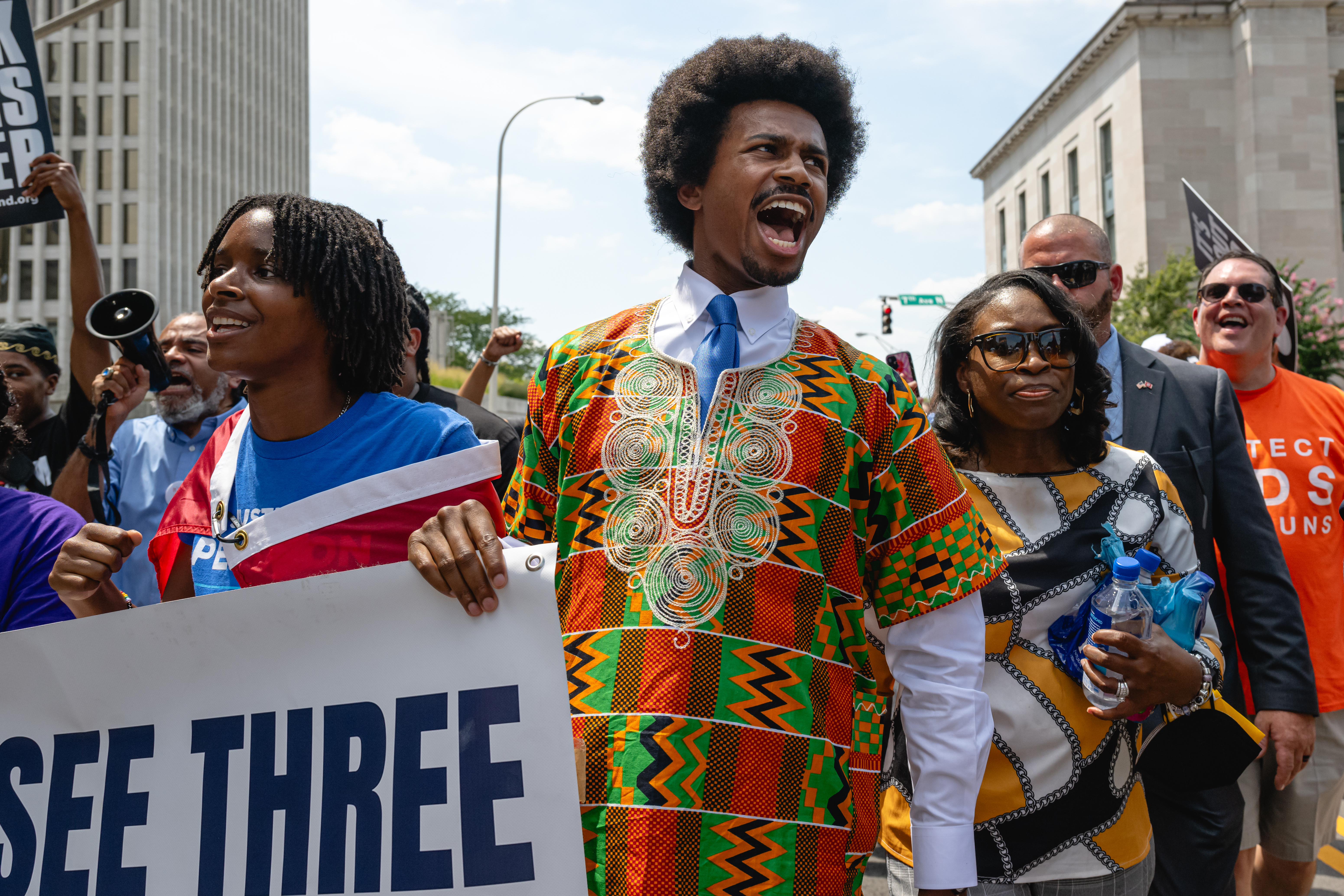
Rep. Justin Pearson

Five months ago, a shooter killed six people at a Christian elementary school in Nashville. On Tuesday, a special session of the Tennessee Assembly sparked by that tragedy ended in shoving, shouting and a Black Memphis Democrat calling the House speaker a white supremacist—and the passage of no laws that would restrict access to guns. 

[time-brightcove not-tgx=”true”]

It was a bleak ending to a tense legislative session that drew national attention to the intractable debate over gun rights in Tennessee, and the efforts by the state’s Republican supermajority to silence those pushing for stronger gun safety laws.

Republican Governor Bill Lee had called for the special session in May in the wake of the mass shooting at the Covenant School, a presbyterian church in Nashville. It lasted just over a week. Numerous proposals restricting access to firearms went nowhere. Videos of the moments after the House adjourned on Tuesday show Rep. Justin Pearson, D-Memphis, trailing Republican House Speaker Cameron Sexton as he begins to leave the chamber. Pearson was holding a sign that said “Protect Kids, Not Guns.”

“I told him that it was shameful that we have wasted time being here and we have not done a single thing to protect our kids,” Pearson tells TIME. “Then, as he’s walking by me, he violently shoves me up towards the clerk’s desk—hitting me in my chest—and then he starts to scream at me as if I had done something to him.” Sexton recounted his side of the incident with reporters on Tuesday, saying Pearson “comes in and pops me.” Sexton did not respond on Wednesday to a request to comment from TIME.

Pearson adds that he has been in touch with lawyers in relation to a personal injury claim against Rep. Sexton over the episode. He says he is concerned that letting it go could normalize such acts in the Capitol, he says.

Ahead of the special session, Lee, a longtime supporter of gun rights who lost two close friends in the shooting, expressed a willingness to sign some gun control legislation. In particular, Lee supported a so-called red flag law that would allow courts and police to temporarily remove firearms from people for up to 180 days if the judge found a “current” and significant risk of harm to themselves or others. But the proposal was unpopular with his own party. “There were low expectations going in. Legislators had already indicated that they were unlikely to do very much in terms of the governor’s request,” says Bruce Oppenheimer, a professor emeritus of political science at Vanderbilt University in Nashville.

Most Republicans did not engage on the topic of restricting firearm access. “I think it’s good to remember that Tennessee is not just Nashville, Tennessee is not just Memphis,” said State Representative Jeremy Faison, a member of the House Republican leadership, according to the New York Times. “There’s literally no one in my district asking me to do anything like what they asked.”

Democrats accused the governor of a failure of leadership. Lawmakers approved funneling more money towards an existing state program that provides free gun safes, and codified an executive order on background checks. It also approved millions of dollars in funding for school safety grants and mental health agencies. The governor has maintained that the special session was a success.

State political observers and activists say they were stunned at the extent to which Republicans worked during the special session to suppress those pushing for stronger gun safety measures. Republicans created new House rules that would allow for the silencing of lawmakers who were viewed as going off-topic, as well as a ban on members of the public holding signs in the House gallery and committee rooms. “Essentially, the House was establishing the right to send dissenting representatives to the corner until they learn their lesson,” says Ken Paulson, director of the Free Speech Center at Middle Tennessee State University. “It could not be more transparent that this body did not want input from constituents or Democrats on the single most important topic to the state at this time.”

Democrats pushed back against Republican claims that the new rules were about maintaining order in the chamber. “These bogus rules were written not with decorum in mind; they were written with race in mind,” says Pearson, who argues the Speaker was trying to “bludgeon dissent of people who do not look like him and who disagree with his positions.”

The sign provision was struck down by a Nashville Court last week after three women who were removed from a House committee meeting for holding signs advocating for gun control sued on first Amendment grounds, with the help of the ACLU. The rule pertaining to lawmakers remained.

Pearson and Rep. Justin Jones, a Nashville Democrat, became national celebrities in April after the Republican supermajority expelled them from their elected seats for taking part in a protest following the school shooting. The duo officially won their seats back in an August special election.
On Monday, the second-to-last day of the special session, Sexton silenced Jones by ruling twice from the House dais that Jones was out of order. That led to a 70-20 vote in support of silencing him for the rest of the day. “I was told that if I keep speaking, I will be silenced for up to three days and then the next offense will be indefinitely,” Jones said. “It sent a chilling effect that you can’t even speak as a representative of your district because you would be silenced permanently.”

Jones disputes that his remarks were off-topic because he spoke about having more mental health counselors as opposed to police in schools for a bill that would have increased law enforcement presence in schools. He alleges that he was silenced because he had sent a letter to all House members saying that he would call for a vote of no confidence in the House Speaker. “The Speaker used that as an opportunity to stop my vote of no confidence,” Jones said. “ He had told his members that he was afraid of the vote of no confidence because apparently some of the Republican members were even frustrated with his leadership.” 

Earlier this month, during a hearing about a proposal to arm teachers, a House subcommittee chairman ordered state troopers to eject protesters from the room for being disruptive. They left in tears. Sarah Shoop Neumann, a mother of a young son at the Covenant School, was among the parents who was temporarily kicked out of the hearing. The restrictions on protesting, she says, “took some dignity away from us, that we couldn’t even hold a sign to honor our school and the lives that were lost.”

She adds that she does not think the special session produced any legislation that will have a material impact on gun violence in Tennessee.

“What we spent all summer hearing was we are so sorry that six people from your school died including three innocent children, but we can’t do anything involving firearms because of the Second Amendment,” Neumann says.


from TIME https://ift.tt/raST1YA

Mutinous Soldiers in Gabon Say They’ve Ousted President

Gabonese soldiers announce they have seized power

(LIBREVILLE, Gabon) — Mutinous soldiers in Gabon said Wednesday they were seizing power to overturn the results of a presidential election, and claimed to have arrested the president, whose family has held power for 55 years.

The coup attempt came hours after the central African country’s President Ali Bongo Ondimba, 64, was declared winner of an election marred by fears of violence.

[time-brightcove not-tgx=”true”]

Within minutes of the announcement, gunfire was heard in the center of the capital, Libreville. Later, a dozen uniformed soldiers appeared on state television and announced that they had seized power.

Crowds took to the city’s streets to celebrate the end of Bongo’s reign, singing the national anthem with soldiers.

“Thank you, army. Finally, we’ve been waiting a long time for this moment,” said Yollande Okomo, standing in front of soldiers from Gabon’s elite republican guard.

Shopkeeper Viviane Mbou offered the soldiers juice, which they declined.

“Long live our army,” said Jordy Dikaba, a young man walking with his friends on a street lined with armored policemen.

The soldiers intended to “dissolve all institutions of the republic,” said a spokesman for the group, whose members were drawn from the gendarme, the republican guard and other elements of the security forces. Later in the day, a second video carried on state television said the president and other people in the government have been arrested on various charges.

French mining company Eramet said it was ceasing all operations in Gabon, and that it has begun procedures to ensure the safety of its staff and facilities. The company’s subsidiaries in Gabon operate the world’s largest manganese mine, and a rail transport company.

The private intelligence firm Ambrey said all operations at the country’s main port in Libreville had been halted, with authorities refusing to grant permission for vessels to leave.

One morning flight at Libreville’s Léon-Mba International Airport already had been delayed early Wednesday morning. A man who answered a number listed for the airport told The Associated Press that flights were cancelled on Wednesday.

The coup attempt came about one month after mutinous soldiers in Niger seized power from the democratically elected government, and is the latest in a series of coups that have challenged governments with ties to France, the region’s former colonizer. Gabon’s coup, if successful would bring the number of coups in West and Central Africa to eight since 2020.

In his annual Independence Day speech Aug. 17, Bongo said “While our continent has been shaken in recent weeks by violent crises, rest assured that I will never allow you and our country Gabon to be hostages to attempts at destabilization. Never.”

Unlike Niger and two other West African countries run by military juntas, Gabon hasn’t been wracked by jihadi violence and had been seen as relatively stable. But nearly 40% of Gabonese ages 15-24 were out of work in 2020, according to the World Bank.

Bongo acknowledged the widespread frustration over rising costs of living in his Aug. 17 speech, and listed measures his government was making to contain fuel prices, make education more affordable, and stabilize the price of baguettes.

Gabon is a member of the OPEC oil cartel, with a production of some 181,000 barrels of crude a day, making it the eighth-largest producer of oil in sub-Saharan Africa. It is home to over 2 million people, and is slightly smaller than the U.S. state of Colorado.

At a time when anti-France sentiment is spreading in many former colonies, the French-educated Bongo met President Emmanuel Macron in Paris in late June and shared photos of them shaking hands.

France has 400 soldiers in Gabon leading a regional military training operation. They’ve not changed their normal operations today, according to the French military.

French Prime Minister Elisabeth Borne said Wednesday: “We are following the situation in Gabon closely.″

The mutinous officers vowed to respect “Gabon’s commitments to the national and international community.”

When asked about Gabon Wednesday, the EU’s top diplomat, Josep Borrell said it would be discussed by EU ministers this week. Defense ministers from the 27-nation bloc are meeting in Spain on Wednesday, and foreign ministers on Thursday. Borrell will chair both meetings, and Niger will also be a focus.

“If this is confirmed, it’s another military coup, which increases instability in the whole region,” he said.

Bongo’s family has long-standing ties to former colonial ruler France, dating to the four-decade presidency of his late father Omar Bongo. These have come under legal scrutiny in recent years.

Several members of the Bongo family are under investigation in France, and some have been given preliminary charges of embezzlement, money laundering and other forms of corruption, according to French media reports, driven in part by a broader push for justice by non-governmental organizations that have long accused multiple African heads of state of embezzling public funds and hiding them in France.

Bongo was seeking a third term in elections this weekend. He served two terms since coming to power in 2009 after the death of his father who ruled the country for 41 years. Another group of mutinous soldiers attempted a coup in January 2019, while Bongo was in Morocco recovering from a stroke, but they were quickly overpowered.

In the election, Bongo faced an opposition coalition led by economics professor and former education minister Albert Ondo Ossa, whose surprise nomination came a week before the vote.

Every vote held in Gabon since the country’s return to a multi-party system in 1990 has ended in violence. Clashes between government forces and protesters following the 2016 election killed four people, according to official figures. The opposition said the death toll was far higher.

Fearing violence, many people in the capital went to visit family in other parts of the country before the election or left Gabon altogether. Others stockpiled food or bolstered security in their homes.

After last week’s vote, the Central African nation’s Communications Minister, Rodrigue Mboumba Bissawou, announced a nightly curfew from 7 p.m. to 6 a.m., and said internet access was being restricted indefinitely to quell disinformation and calls for violence.

NetBlocks, an organization tracking internet access worldwide, said internet service saw a “partial restoration” in Gabon after the coup.

— Mednick reported from Dakar, Senegal. Associated Press reporters Cara Anna in Nairobi, Kenya, Jamey Keaton in Geneva; Angela Charleton in Paris; and Jon Gambrell and Malak Harb in Dubai, United Arab Emirates contributed.


from TIME https://ift.tt/wAun5K2

Congress Can’t Erode Airplane Safety Rules That Save Lives

United Airlines Airplanes at Newark Liberty Airport, New Jersey

On a foggy night in February 2009, Colgan Air Flight 3407 took off from Newark Airport, heading for nearby Buffalo, New York. Fifty-nine minutes later, the aircraft crashed into a house, killing all 49 passengers and crew on board, along with one person on the ground.

[time-brightcove not-tgx=”true”]

Immediately, the U.S. National Transportation Safety Board began an investigation into the crash, soon determining it was caused by pilot error due to lack of experience with icing conditions. As a result, Congress acted to strengthen training requirements for all passenger airline pilots, including, crucially, instituting what’s known as the 1,500 hour rule: a regulation mandating that pilots earn a minimum of 1,500 real world flight hours before being allowed to work for an airline, with an adequate portion of those hours spent flying in difficult operational conditions.

There has not been a single passenger death caused by pilot error in commercial aviation since the rule was enacted, proving a core principle we all know to be true: that experience matters. Yet, right now, several of my colleagues are trying to gut the 1,500 hour rule, proposing legislation that would produce less experienced pilots and represent an unacceptable backsliding as well as a dangerous complacency in an industry where complacency kills. They’re supposedly doing so in an effort to address the recent pilot shortage—but this so-called solution does anything but solve the problem, and seems more akin to addressing a doctor shortage by slashing the amount of training medical school students need to earn their degree.

The thing is, existing law already allows for some exemptions—but always based on safety, not temporary labor conditions. For example, the FAA allows for an expedited pathway for military and former military pilots, and on occasion it credits time spent in certain academic training courses, but only if such courses enhance safety more than requiring a pilot to fully comply with the full 1,500 hour requirement.

To me, there has never been a worse time to weaken pilot regulations, as 2023 has already been a chilling year for our civil aviation system. We’ve witnessed a disturbing rise of near-deadly close calls—an uptick that the NTSB deemed a national safety crisis and that led the FAA to convene an unprecedented safety summit.

As both a former Army pilot and as the current Chair of the Senate’s Aviation Safety Subcommittee, I refuse to respond to these near-misses by further reducing pilot training. I refuse to be complicit in efforts to compromise my constituents’ safety. Instead, I’m doing everything in my power to convince my colleagues to proactively strengthen safety measures so that these close calls never become precursors to tragedy.

When I was serving in Iraq, I learned all too well the value of real-world experience. After all, I am only able to write this today—I am only alive today—because of the immense skills shown by my flight crew, which were earned through countless in-the-sky flight hours.

On November 12, 2004, an RPG tore through the cockpit of the Black Hawk I was co-piloting. We were 10 feet above the trees, we’d lost all ofour avionics and total hydraulic failure was likely next. There was no way, no chance, that we should’ve been able to land the aircraft. In fact, in my decade-plus of training as a military pilot, every time—every single time—that we simulated a similar scenario, we died. The understanding was that that kind of catastrophe was simply not survivable.

And yet, on that day in Iraq, we did. 

We fought to regain control of our helicopter. And led by the expertise of my pilot-in-command, we safely landed our aircraft. We survived.

This was only possible because actual, in-air flight experience prepared us to respond to the most desperate of situations with levels heads and swift action. Unlike in a simulator, there is no “pause” button in flight. So it is that training that I have to thank for being alive today—for my family, for my career, for my very breath.

I’m not the only one pleading with my colleagues to uphold this rule. The Hero of the Hudson, Captain Sully Sullenberger, has also implored Congress not to get complacent, trying to get them to understand that the combined 40,000-plus flight hours between him and his first officer were critical in saving the 155 lives onboard his plane the day he safely landed on the Hudson River.

Do you think that prior to that afternoon there were any flight simulations of a dual engine failure from bird strike followed by a water landing? Of course not. In fact, even when that simulation was run after the Miracle on the Hudson, even with flight crews expecting the scenario, they still crashed time after time. It was only thanks to the pilots’ experience that those 155 people made it home to their families that January night.

While I truly believe that simulators are a valuable training tool, I myself have used them, and that’s why is I know they are no substitute for the real thing. For example, a simulator cannot replace the experience of walking around your aircraft and seeing ice accumulating on your wing surfaces. Life-saving instincts are earned through thousands of hours of piloting a real aircraft with real lives at stake. So while I understand that the perfect storm of major carriers buying out thousands of their most-experienced pilots combined with a post-pandemic surge in air travel has created a temporary shortage of pilots and first officers, it is critical that we resist the false promise of a quick-fix that could increase lives lost in a preventable tragedy.

The FAA seems to agree. Last year, they rejected a petition for an exemption to the flight hours requirement, stating that they had “previously concluded the argument that an exemption would serve to address a pilot shortage is overly simplistic and does not present a persuasive argument.”

So as both a professional pilot and as a mom who regularly travels with my two little girls, I am holding the line on safety. Now is not the time to go backward. Now is not the time to cut corners. Now is not the time to put corporate profits ahead of American lives. Anyone who refuses to see sense here—anyone who votes to reduce the 1,500 hour rule for pilot training—will have blood on their hands when the inevitable accident occurs thanks to an inadequately trained flight crew.


from TIME https://ift.tt/xWof1Y5

All the Ways We Deny Antisemitism

PITTSBURGH, PA - APRIL 21: Tree of Life Synagogue is the site

I’ve served as a congregational rabbi for a decade or so. My leadership has coincided with an ominous rise in antisemitic incidents from vile online threats to the killing of 11 Jews at a Pittsburgh synagogue in 2018. During that time, I’ve listened to hundreds of conversations detailing real life encounters of antisemitism. I’ve heard diverse opinions and a wide range of experiences about its nature in the present day—from a swastika drawn in the bathroom of a school to microaggressions in the workplace and everything in between. But nearly every conversation I hear about antisemitism has one, surprising thing in common: in every instance where an antisemitic act has been committed, our culture—and conversations surrounding these hateful acts—tend to diminish or even deny antisemitism.

[time-brightcove not-tgx=”true”]

Think about the national conversation around antisemitism. When Kanye West went on his repugnant rant against Jews in October 2022, one of the internet’s first reactions was that he was not antisemitic, he was mentally ill. But both can be true. Or think about social media where anti-Jewish rhetoric has spiked, particularly on X (formerly Twitter). Yet some continue to insist it’s not antisemitism, it’s free speech. Or when, during a concert in Berlin in May 2023, Roger Waters, the outspoken critic of Israel and former frontman of Pink Floyd, donned a full length black coat with a red arm band and invoked the name of the murdered Jewish teenager Anne Frank, he explained that his actions were not antisemitic, they were “a statement in opposition to injustice.” The Berlin police opened an investigation into Waters for suspicion of incitement.

This tendency to diminish or even deny antisemitism in public discourse has damaging implications for everyday life. It can make people—both Jewish and not—feel hesitant to call out antisemitism when we see it.

Read More: 3 Lessons About Anti-Semitism We Should Learn From the Pittsburgh Synagogue Attack

I’ve heard this tendency to diminish antisemitism in my own life many times. We tell ourselves that today’s antisemitism is nowhere near as bad as the violence our grandparents and great grandparents encountered. So is it really worth mentioning? Or we tell ourselves that other forms of repugnant hatred—racism, misogyny, homophobia—are exponentially worse problems than antisemitism, so maybe we shouldn’t even raise antisemitism as a concern at all. We tell ourselves that antisemitism is not so bad (or not as bad as), and so we say nothing, or we doubt ourselves.

I, myself, am not immune to this propensity to disbelieve that antisemitism is real and pervasive. In the summer of 2020, amidst the Black Lives Matter Protests, someone with a baseball bat attacked the glass door of my synagogue; hitting the reinforced glass repeatedly until it cracked. It’s not antisemitism, I told myself, it’s part of a larger social justice movement. No one would attack my synagogue with any particular intention, I thought. Right?

We have a cultural problem accepting that antisemitism exists, persists, and thrives in America. But it does. Antisemitic incidents in the U.S. are at an all time high, according to a March 2023 report by the Anti Defamation League (ADL). Schools and synagogues are growing targets of this horrific hate. Jews are less safe in the U.S. than we have ever been before. So it’s worth asking: why do we shy away from calling out this hate? Why do we allow this practice of antisemitism denial to continue?

There are lots of reasons, actually.

Sometimes, we don’t call out antisemitism because we simply can’t. We don’t know the first thing about Jews, Jewish history, or the history of Jew hate. And even if you are Jewish, you may not feel like you know enough about antisemitism to talk about it. You may feel ambivalent about Judaism and a little bit embarrassed about how little you know. You may have never studied Judaism as an adult. Or perhaps, talk of antisemitism makes you feel like an imposter. How can you claim to be a victim of antisemitism when, overall, America has been so good to you?

Other times, we deny antisemitism for a completely different reason. We hide from it because the resurfacing of Jew hate in this country is simply too terrifying to consider. But the Neo Nazi marches and tiki torches are real. The pro-white, anti-Jewish fliers pinned on community bulletin boards and pasted to telephone poles are real. The letters I’ve received in the mail, the comments I read online, the dollar signs spray-painted on my friends’ synagogues are real. Sometimes we diminish antisemitism because acknowledging it is just too scary. But where will ignoring it lead us?

There are times where we don’t name the fullness of antisemitism for an entirely different reason: because we don’t want to rock the boat. Some people within our own communities seem sort of comfortable with antisemitism, or at least pretty comfortable minimizing it—so it can be deeply uncomfortable to go against the grain and call it out.

And sometimes we diminish antisemitism because antisemitism is working. Maybe a small part of you believes its lies. If somewhere in your mind you imagine Jews as powerful, rich, white, running Hollywood, influencing the media, or controlling the political landscape, then a part of you likely believes that Jews exist at the top of our cultural pyramid. So in that case, why would you call out antisemitism at all?

But it’s time to stop our ignorance and ambivalence, and start talking about antisemitism.

Because it’s the worst it’s been in my lifetime—and probably yours. Instead of denying, diminishing and avoiding antisemitism, we need to name it and face it head on.    


from TIME https://ift.tt/SDBitrq

Tuesday, August 29, 2023

How Seafood Became the Latest Flashpoint in Korean Politics

SKOREA-JAPAN-NUCLEAR SAFETY-IAEA-FUKUSHIMA

South Korean President Yoon Suk Yeol is going all out to convince citizens that seafood is safe to consume.

On Sunday, the presidential office announced that it would serve Korean seafood at its cafeteria for the whole of this week, and continue to provide seafood at least twice a week afterward. The President himself had seafood at lunch on Monday, a presidential office spokesperson said.

[time-brightcove not-tgx=”true”]

Authorities are also meeting with corporate meal service providers to discuss serving more seafood to employees of companies. And there has also been talk of increasing seafood in meals for the military and schools. Sixty-four billion won ($48.4 million) has been budgeted for vouchers for consumers to spend on seafood and sea salt, as well as 115 billion won ($87 million) in financial aid to the seafood industry.

At the same time, Yoon’s political opponents have been leading protests and claiming that his government is bulldozing through public safety concerns and turning a blind eye to an alleged “crime to humanity” committed by Japan, which started releasing treated wastewater from the Fukushima nuclear power plant last week.

Read More: Japan Is Releasing Wastewater Into the Pacific: What to Know About Radioactivity and Seafood

The topic of seafood safety has in recent months emerged to be a heated flashpoint in South Korean politics. While Yoon’s government tries to retain public confidence in the country’s seafood supply, opposition parties say that these attempts are clouded by a desire to deepen a budding friendship with Japan at the expense of public health and glossing over historical injustices.

Meanwhile, the country’s seafood industry—one of the biggest in the world—is swimming in uncertainty, with over 90% of South Korean consumers saying that they would reduce their seafood consumption because of safety concerns. This unease has continued to pervade the seafood market despite scientists saying that the wastewater poses a very low risk of radiotoxic effects.

“While the data hasn’t shown much yet, the Korean seafood industry is expected to suffer for a while because of the psychological anxiety,” Eunjung Lim, an associate professor of international studies at Kongju National University, tells TIME.

“This issue is not, and should not be, about Korea-Japan relations, but it has already become a political issue of how we view Japan and how we view cooperation with Japan,” says Lim.

When Japan first announced its plan to release treated wastewater from Fukushima’s nuclear plant in 2021, it was met with immense anger from the South Korean government, then led by President Moon Jae-in from the center-left Democratic Party. Authorities denounced the decision as “outright unacceptable” and threatened legal action at the time.

But under Yoon’s administration, which took power in 2022, South Korea did a 180 on the issue as it has sought to mend ties with Japan. When a joint survey conducted by Korean and Japanese newspapers in June showed that 84% of Korean respondents opposed the wastewater release, a Korean official said that the government should not make its decision based on an opinion poll. In July, the Yoon-led government endorsed the safety of Japan’s wastewater plans—in stark contrast to the positions taken by other countries in the region, including China, which has implemented further bans on Japanese seafood imports since last week.

Read More: How South Korea’s Yoon Suk-yeol Capitalized on Anti-Feminist Backlash to Win the Presidency

Yoon’s stance has been criticized by opposition parties who point to the country’s bitter history with Japan, which the Democratic Party described as a “war criminal nation” that has “once again emerged as a global troublemaker by deciding to release the radioactive water into the ocean.”

“The opposition Democratic Party has a very different historical sense of national identity than the ruling People Power Party,” Lim explains.

Yoon, for his part, has placed clear emphasis on improving South Korea’s ties with Japan and the United States as a way to stave off the ever looming threat from North Korea.

Earlier this month, in an inaugural trilateral summit at Camp David, Yoon met with Kishida and U.S. President Joe Biden to strengthen the partnership between the three countries amid rising geopolitical tensions in the Asia-Pacific region.

Read More: The U.S. Is Beefing Up Alliances Across Asia—But Don’t Expect an ‘Asian NATO’ Anytime Soon

Despite the domestic backlash he faces at home, “it would have been hard for [Yoon] to undermine the momentum of trilateral cooperation over something that is scientifically unproblematic,” says Lim. “The deep-rooted distrust of Japan in the minds of South Koreans and the trauma of Japan’s past actions have made this issue a bigger political issue than it needs to be.”


from TIME https://ift.tt/krt85ZH

Here Are the First 10 Drugs Biden Will Target for Price Negotiations

Joe Biden

WASHINGTON (AP) — The popular diabetes treatment Jardiance and the blood thinner Eliquis are among the first drugs that will be targeted for price negotiations in effort to cut Medicare costs.

President Joe Biden’s administration on Tuesday released a list of 10 drugs for which the federal government will take a first-ever step: negotiating drug prices directly with the manufacturer.

[time-brightcove not-tgx=”true”]

The move is expected to cut costs for some patients but faces litigation from the drugmakers and heavy criticism from Republican lawmakers. It’s also a centerpiece of the Democratic president’s reelection pitch as he seeks a second term in office by touting his work to lower costs for Americans at a time when the country has struggled with inflation.

The diabetes treatment Jardiance from Eli Lilly and Co. is on the list with Amgen’s autoimmune disease treatment Enbrel. Other drugs include Entresto from Novartis, which is used to treat heart failure.

Medicare spent about $10 billion in 2020 on Eliquis, according to AARP research. It treats blood clots in the legs and lungs and reduces the risk of stroke in people with an irregular heartbeat called atrial fibrillation.

Biden plans to deliver a speech on health care costs from the White House after the announcement. He’ll be joined by Vice President Kamala Harris.

More than 52 million people who either are 65 or older or have certain severe disabilities or illnesses get prescription drug coverage through Medicare’s Part D program, according to the Centers for Medicare and Medicaid Services, or CMS.

About 9% of Medicare beneficiaries age 65 and older said in 2021 that they did not fill a prescription or skipped a drug dose due to cost, according to research by the Commonwealth Fund, which studies health care issues.

CMS aims to negotiate the lowest maximum fair price for drugs on the list released Tuesday. That could help some patients who have coverage but still face big bills like high deductible payments when they get a prescription.

Currently, pharmacy benefit managers that run Medicare prescription plans negotiate rebates off a drug’s price. Those rebates sometimes help reduce premiums customers pay for coverage. But they may not change what a patient spends at the pharmacy counter.

The new drug price negotiations aim “to basically make drugs more affordable while also still allowing for profits to be made,” said Gretchen Jacobson, who researches Medicare issues at Commonwealth.

Drug companies that refuse to be a part of the new negotiation process will be heavily taxed.

The pharmaceutical industry has been gearing up for months to fight these rules. Already, the plan faces several lawsuits, including complaints filed by drugmakers Merck and Bristol-Myers Squibb and a key lobbying group, the Pharmaceutical Research and Manufacturers of America, or PhRMA.

___

Murphy reported from Indianapolis.


from TIME https://ift.tt/dpmN16G

Discovering Joy After My Family’s Traumas During the Vietnam War

ME.WildArt.Reflection.0308.DK.Reflective mood this morning in little Saigon at the site of the antic

As a second-generation Vietnamese American I spent much of my youth railing against my heritage. The reasons were as simple as being a normal rebellious teenager, and as complex as not understanding how PTSD could be a catalyst for generational trauma. As an adult I’ve worked hard to appreciate where I come from, but earlier in 2023 at an online Áccented event hosted by the Diasporic Vietnamese Artists Network (DVAN), I found myself, once again, at odds with my community.

[time-brightcove not-tgx=”true”]

In the chatroom, a flurry of discussions about the Vietnamese diaspora chased each other up my screen when a thumbnail caught my eye. In the photo, a smiling Vietnamese girl posed with the “peace” sign. Her purple pigtails danced in the static picture, and beside her face was the question: “When can we talk about Viet Joy?” She was tired of Vietnamese people being synonymous with the Vietnam War. Claps and raised hands emojis celebrated the comment. I waited for someone to interject, or merely even say, it’s not that simple. When no one did, I exited the conversation. Alone, I fumed.

What is so wrong about wanting joy? I’ll get to that, but first we need to rewind a few years. Okay, a lot of years—to 1994 when I was nine.

A keychain with white block letters swung from the zipper of my green JanSport backpack. The letters spelled my name, “J-A-M-I-E,” and there was a dolphin at the bottom. I’d just finished the first day of fourth grade. Fresh off a move from Tustin to Orange, California, I was new at this school. Walking toward my cousins’ carpool, I stared at my feet partly because eye contact made me queasy but also because of my tendency to trip over air.

“I like your keychain. Dolphins are my favorite animal, too,” a voice said. I looked up into the piercing blue eyes of a girl with blonde hair and beautiful tan highlights in her Goldilocks curls. 

“I like your name,” I said. While I was typically bad at remembering names, I knew hers for two reasons: One, because it was embroidered across her plush purple backpack and, two because we had the same name spelled slightly differently: “Jamie” and “Jaime.” But a difference in spelling was hardly a reason not to be friends. Our obvious commonalities had BFF written all over us. When she told me she swam with dolphins over the summer, I immediately thought of matching “Best” and “Friend” lockets.

“Wanna eat together at lunch tomorrow?” I asked.

“I can’t.” The words burned in my ears. Experience told me I should know better, but I was desperate for a companion. I wanted to say something that would change her mind, but before I had a chance, she added, “My mom would kill me if she knew we were friends. She hates your kind.” I smiled—a nervous reflex—and we parted ways. I’d always known the Vietnam War was unpopular in America, I’d just never had it said directly to my face.

There were many other instances like this in my formative years, but for the sake of this story, let’s call this the beginning. This moment marked the start of an intense desire to shift away from all things Vietnamese. If Jaime’s mom, sitting behind the steering wheel of her brown minivan more than 100 yards away, could tell that something was wrong with “my kind,” my deficiencies must have been pretty obvious. 

Fast forward to 1995, when my family visited Vietnam for the first time since my parents fled as refugees. I was 10 years old, wearing butterfly shorts and a white T-shirt. I followed behind my mom and older sister in a crowded outdoor market. We’d been in the country less than 48 hours, and I’d already heard (from strangers, mind you) that I was “the ugly sister,” “fat,” “round,” “chubby,” and had a “face that is easy to hate.” Apparently, that last one was a compliment—similar to “Her cheeks are so cute I just want to pinch them,” but I didn’t see how the two were comparable. “If you can’t see, it’s because your eyes are broken,” my mother told me.

Four years later, on February 26, 1999, Vietnamese protesters headlined the news throughout the U.S. A video store owner in Westminster, Calif. put up a picture of Ho Chi Minh alongside the Communist Vietnamese flag. Tensions were high, the posters people carried were chilling, and I felt a shame and sadness I couldn’t yet explain. I was not a refugee, but it bothered me to know that this was the country my parents grew up in. This Vietnam I saw in the posters was my mom and dad’s beloved homeland—my ancestral culture. And it was broken.

The year of the protests marked a turning point in my narrow-minded perspective. I tiptoed into my family’s history collecting only a few stories because no one wanted to discuss the past. But one memory, in particular, laid heavy on my chest. My grandmother, Mẹ, lost her husband in her late 30s. With six kids to feed and bombs dropping from the sky as frequently as rain, she dug a ditch deep enough for her youngest three (two were under the age of 5, and one was my mother) to fit, covered the hole with boards, and left them there while she walked the streets selling her goods. At four ft., eight in. tall, Mẹ was a warrior.

Read More: 50 Years After 1968, We Are Still Living In Its Shadow

Then in 2017, my uncle, whose PTSD mirrored my dad’s but couldn’t be hidden, passed away. His death took with it answers to questions my generation never figured out how to ask. As his body was laid to rest, I wondered if he ever found joy after the war. I’ll never know. Without a record, death erases history.

All my life I’ve struggled with what it means to be Vietnamese American. But I took my friends to try phở when it became trendy. Occasionally, I pronounced the name like I didn’t speak Vietnamese, like I hadn’t eaten this dish my entire life. I put on an “aó dài” for my wedding. And I unraveled my thoughts into a young adult book about intergenerational trauma as witnessed through my own “broken” eyes.

By the time I logged into the DVAN event, I had spent more than two decades unpacking personal trauma while building an emotionally empathic bridge toward my parents, my grandparents, my great-grandparents, and my Vietnam. The wooden slats connecting one step to next were arduous to build and left calluses that eventually healed into scars. Joy was not part of this journey. Guilt, shame, fury, regret, comprehension, and appreciation, yes. But not joy.

Because of this, my purple-haired nemesis’ comment felt like a personal affront. It read to me as, “Why don’t you just get over it?” Angry and hurt, I ruminated on this term, “Viet Joy.” When no answers emerged I did the only thing that seemed productive: I researched. Moving from one webpage to the next, I scoured the internet for examples. There are none. Viet Joy is not yet a concept in motion. Vindication should have tasted sweet; instead, my mouth was sour. The catalyst for my rage against Viet Joy suddenly looked a lot like jealousy.

Changing my approach, I considered where the term came from. Viet Joy is an iteration of Black Joy. I first learned about Black Joy from bookstagrammers who posted stacks of books written by African Americans which did not center on Black trauma. The Smithsonian defines Black Joy as “an effective tool that has allowed individuals and groups to shift the impact of negative narratives and events in their favor.” I love this term, and the hashtag led me to some of my favorite books, like Slay by Brittney Morris and Legendborn by Tracy Deonn.

As my mind initiated a shift, Viet Joy lingered at the edge of all my thoughts. The artistry manifested through Black Joy was inspiring, and the opportunity to create a space within my own head, controlled by my own thoughts, where I might love who I was, was a powerful draw. “Who could I be if I learned to like myself?” I wondered.

I read on. I learned that Black Joy is an affirmation that gives ownership of joy back to the person, how it is a form of resistance, and how it is not about forgetting.

The #BlackJoy hashtag led me to The Black Joy Project. Created by Kleaver Cruz, the Instagram page is filled with hundreds of posts where individuals defined Black Joy. The unifying thread that connects Black Joy is not made up of a single idea that all Black people believe. Black Joy is first a collective support for the “each” while knowing that what follows is the “and every.” It was here that I discovered that Viet Joy didn’t need to be singularly defined. Its meaning can change with each person. And each and every definition is valid.

My error in judgment now glared at me. “Each and every definition is valid.” She was not the problem. I was. I could not accept her idea of Viet Joy because the ease with which she embodied the concept felt unearned. Why? Because if two paths exist and they both lead to the same destination, but one lets a person skip along while the other demands they crawl on their hands and knees across shards of broken glass, I would choose the latter option. The hardships my parents experienced after the war conditioned them to believe that the easier path was a trap. This was what they taught me and, therefore, what I expected of this purple-haired girl.

But this is how the cycle of generational trauma continues. Suffering begets suffering. My parents suffered, then passed their suffering along to me, and I suffered, so now I want this stranger to suffer, as well. Except I don’t want to perpetuate the cycle. If I can, I’d like to break it.


from TIME https://ift.tt/HCL9Xin