Tuesday, October 31, 2023

Yemen’s Houthi Rebels Claim Attacks on Israel, Raising Risk of Widened Conflict

YEMEN-PALESTINIAN-ISRAEL-CONFLICT-DEMO

DUBAI, United Arab Emirates — Yemen’s Houthi rebels for the first time Tuesday claimed missile and drone attacks targeting Israel, drawing their main sponsor Iran closer into the ongoing Israel-Hamas war in the Gaza Strip and further raising the risks of a regional conflict erupting.

The Houthis had been suspected of an attack earlier this month targeting Israel by sending missiles and drones over the crucial shipping lane of the Red Sea, an assault that saw the U.S. Navy shoot down the projectiles.

[time-brightcove not-tgx=”true”]

This time on Tuesday, however, Israel said its own fighter jets and its new Arrow missile defense system shot down two salvos of incoming fire hours apart as it approached the country’s key Red Sea shipping port of Eilat.

The Houthis, who have held Yemen’s capital, Sanaa, since 2014 as part of that country’s ruinous war, claimed three attacks on Israel in a later military statement, without elaborating on the timeframe of the operations and whether Tuesday’s salvos represented one or two attacks.

Beyond the attack that saw the U.S. shoot down missiles, there had been a mysterious explosion Thursday that hit the Egyptian resort town of Taba, near the border with Israel. The blast, which Egyptian authorities have not explained, wounded six people.

Read More: How the Israel-Hamas War Could Pull in Arab Nations

″Our armed forces launched a large batch of ballistic missiles and a large number of drones at various targets of the Israeli enemy,” Houthi military spokesman Brig. Gen. Yahya Saree said in a televised statement. “The Yemeni Armed Forces confirm that this operation is the third operation in support of our oppressed brothers in Palestine and confirm that we will continue to carry out more qualitative strikes with missiles and drones until the Israeli aggression stops.”

For Israel, Tuesday’s attack marked an incredibly rare reported in-combat use of the Arrow missile defense system, which intercepts long-range ballistic missiles with a warhead designed to destroy targets while they are in space, according to the Washington-based Center for Strategic and International Studies.

“All aerial threats were intercepted outside of Israeli territory,” the Israeli military said. “No infiltrations were identified into Israeli territory.”

However, the missile fire sparked a rare air raid siren alarm to go off in Eilat, some 250 kilometers (155 miles) south of Jerusalem, sending people fleeing into shelters.

Saree did not identify the specific weapons used in the attack. However, the use of the arrow suggests it was a ballistic missile. The Houthis have a variant of its Burkan ballistic missile, modeled after a type of an Iranian missile, believed to be able to reach over 1,000 kilometers (620 miles) to strike near Eilat.

The incoming fire comes as the troop-and-aircraft-carrying USS Bataan and other elements of its strike group are likely in the Red Sea now, along with other U.S. vessels.

Air Force Brig. Gen. Pat Ryder, the Pentagon’s press secretary, acknowledged the Houthi fire targeting Israel, suggesting the rebels had missiles able to reach some 2,000 kilometers (1,240 miles).

“This is something we will continue to monitor,” Ryder said. “We want to prevent a broader regional conflict.”

Read More: As Biden Responds to Iran-Linked Attacks With Air Strikes, Fears of a Wider War Grow

Saudi Arabia also did not respond to questions. The kingdom saw four of its soldiers killed in its southern Jazan province in recent days in fighting with the Houthis, according to a report Tuesday by Bloomberg citing anonymous sources. That’s even as Saudi Arabia has tried for months to reach a peace deal with the Houthis after a yearslong deadlock war against them.

The Houthis’ declaration further drew Iran into the conflict. Tehran has long sponsored both the Houthis and Hamas, as well as the Lebanese Shiite militia group Hezbollah, which continues to trade deadly cross-border fire with the Israelis. U.S. troops also have been targeted in drone attacks on bases in Iraq and Syria claimed by Iranian-allied militia groups since the war started.

The Houthis follow the Shiite Zaydi faith, a branch of Shiite Islam that is almost exclusively found in Yemen. The rebels’ slogan has long been: “God is the greatest; death to America; death to Israel; curse the Jews; victory to Islam.”

But “now they have the hard power to back it,” said Thomas Juneau, a professor at the University of Ottawa who has studied Yemen for years.

“It was just a matter of time before they would be able to do this,” Juneau said, noting the rebels’ steadily advancing missile program that came with Iranian assistance. “The fact that there’s another front directly to the south raises the risk that Israel (air defenses) can be overwhelmed and then it can be that much more worrying” if Hezbollah, Hamas and others launch massive missile barrages.

Read More: Militant Group Hezbollah Is on the Sidelines of the Israel-Hamas War. Here’s What to Know

Iran has long denied arming the Houthis even as it has been transferring rifles, rocket-propelled grenades, missiles and other weaponry to the Yemeni militia using sea routes. Independent experts, Western nations and United Nations experts have traced components seized aboard other detained vessels back to Iran.

The reason for that likely is a U.N. arms embargo that has prohibited weapons transfers to the Houthis since 2014.

There also has been at least one attack that the Houthis claimed where suspicion later fell fully on Iran. In 2019, cruise missiles and drones successfully penetrated Saudi Arabia and struck the heart of its oil industry in Abqaiq. That attack temporarily halved the kingdom’s production and spiked global energy prices by the biggest percentage since the 1991 Gulf War.

While the Houthis claimed the Abqaiq attack, the U.S., Saudi Arabia and analysts blamed Iran. U.N. experts similarly said it was “unlikely” the Houthis carried out the assault, though Tehran denied being involved.

Iran’s mission to the U.N. warned in a statement to The Associated Press that allied militias like the Houthis could expand their operations against Israel.

“The warnings from Iran regarding the initial days of the Gaza civilian casualties highlighted a concern: if these atrocities were not halted, they could incite public outrage and exhaust the patience of the resistance movements,” the Iranian mission said. “These concerns can be averted and the responsibility lies squarely in the hands of the American administration to halt the transgressions perpetuated by the Israeli regime.”

—Associated Press writers Jack Jeffrey and Sam Magdy in Cairo contributed to this report.


from TIME https://ift.tt/GwalJc9

U.N. Agency in Gaza Says Ceasefire Represents ‘Matter of Life and Death for Millions’

Death toll rises in Gaza due to Israeli attacks

The head of the United Nations agency for Palestinian refugees told a U.N. emergency meeting Monday “an immediate humanitarian cease-fire has become a matter of life and death for millions,” accusing Israel of “collective punishment” of Palestinians and the forced displacement of civilians.

[time-brightcove not-tgx=”true”]

Philippe Lazzarini warned that a further breakdown of civil order following the looting of the agency’s warehouses by Palestinians searching for food and other aid “will make it extremely difficult, if not impossible, for the largest U.N. agency in Gaza to continue operating.”

Briefings to the Security Council by Lazzarini, the head of the U.N. children’s agency UNICEF and a senior U.N. humanitarian official painted a dire picture of the humanitarian situation in Gaza 23 days after Hamas’ surprise Oct. 7 attacks in Israel, and its ongoing retaliatory military action aimed at “obliterating” the militant group, which controls Gaza.

Read More: Israel’s 4 Bad Options in Gaza

According to the latest figures from Gaza’s Ministry of Health, more than 8,300 people have been killed — 66% of them women and children — and tens of thousands injured, the U.N. humanitarian office said.

UNICEF Executive Director Catherine Russell that toll includes over 3,400 children killed and more than 6,300 injured. “This means that more than 420 children are being killed or injured in Gaza each day — a number which should shake each of us to our core,” she said.

Lazzarini said: “This surpasses the number of children killed annually across the world’s conflict zones since 2019.” And he stressed, “This cannot be ‘collateral damage.’”

Many speakers at the council meeting denounced Hamas’ Oct. 7 surprise attacks on Israel that killed over 1,400 people, and urged the release of some 230 hostages taken to Gaza by the militants. But virtually every speaker also stressed that Israel is obligated under international humanitarian law to protect civilians and their essentials for life including hospitals, schools and other infrastructure — and Israel was criticized for cutting off food, water, fuel and medicine to Gaza and cutting communications for several days.

Lazzarini said “the handful of convoys” allowed into Gaza through the Rafah crossing from Egypt in recent days “is nothing compared to the needs of over 2 million people trapped in Gaza.”

“The system in place to allow aid into Gaza is geared to fail,” he said, “unless there is political will to make the flow of supplies meaningful, matching the unprecedented humanitarian needs.”

The commissioner-general of the U.N. agency known as UNRWA said there is no safe place anywhere in Gaza, warning that basic services are crumbling, medicine, food, water and fuel are running out, and the streets “have started overflowing with sewage, which will cause a massive health hazard very soon.”

UNICEF oversees water and sanitation issues for the U.N., and Russell warned that “the lack of clean water and safe sanitation is on the verge of becoming a catastrophe.”

Read More: ‘Our Death Is Pending.’ Stories of Loss and Grief From Gaza

U.S. Ambassador Linda Thomas-Greenfield urged the divided Security Council — which has rejected four resolutions that would have responded to the Oct. 7 Hamas attacks and the ongoing war — to come together, saying “the humanitarian crisis in Gaza is growing more dire by the day.”

Stressing that all innocent civilians must be protected, she said the council must call “for the immediate and unconditional release of all hostages, address the immense humanitarian needs of Palestinian civilians in Gaza, affirm Israel’s right to defend itself from terrorism, and remind all actors that international humanitarian law must be respected.” She reiterated President Joe Biden’s calls for humanitarian pauses to get hostages out and allow aid in, and for safe passage for civilians.

“That means Hamas must not use Palestinians as human shields — an act of unthinkable cruelty and a violation of the law of war,” the U.S. ambassador said, “and that means Israel must take all possible precautions to avoid harm to civilians.”

In a sign of increasing U.S. concern at the escalating Palestinian death toll, Thomas-Greenfield told the council Biden reiterated to Israeli Prime Minister Benjamin Netanyahu on Sunday “that while Israel has the right and responsibility to defend its citizens from terrorism, it must do so in a manner consistent with international humanitarian law.”

“The fact that Hamas operates within and under the cover of civilians areas creates an added burden for Israel, but it does not lessen its responsibility to distinguish between terrorists and innocent civilians,” she stressed.

Following the rejection of the four resolutions in the 15-member Security Council — one vetoed by the U.S., one vetoed by Russia and China, and two for failing to get the minimum nine “yes” votes — Arab nations went to the U.N. General Assembly last Friday where there are no vetoes.

The 193-member world body adopted a resolution calling for humanitarian truces leading to a cessation of hostilities by a vote of 120-14 with 45 abstentions. Now, the 10 elected members in the 15-member Security Council are trying again to negotiate a resolution that won’t be rejected. While council resolutions are legally binding, assembly resolutions are not though they are an important barometer of world opinion.

Israel’s U.N. Ambassador Gilad Erdan was sharply critical of the council’s failure to condemn Hamas’ attacks and asked members: “Why are the humanitarian needs of Gazans, the sole issue, the sole issue you are focused on?”

Read More: The World Must Know What Hamas Has Inflicted Upon Israel

Recalling his grandfather who survived Nazi death camps but whose his wife and seven children perished in the Auschwitz gas chamber, Erdan told the council he will wear a yellow star — just as Hitler made his grandfather and other Jews wear during World War II — “until you condemn the atrocities of Hamas and demand the immediate release of our hostages.”

The ambassador then put a large six-pointed yellow star of David saying “Never Again” on his suit jacket, as did other Israeli diplomats sitting behind him, and said: “We walk with the yellow star as a symbol of pride, a reminder that we swore to fight back to defend ourselves. Never again is now.”

Riyad Mansour, the Palestinian U.N. ambassador, also urged the Security Council to follow the General Assembly, end its paralysis, and demand “an end to this bloodshed, which constitutes an affront to humanity, war crimes, and crimes against humanity, and a clear and imminent danger for regional and international peace and security.”

“Save those who still can be saved and bury in a dignified manner those who have perished,” Mansour said.


from TIME https://ift.tt/u0bQ9T1

Monday, October 30, 2023

Actor Robert De Niro Testifies Against Abusive Boss Allegations by Ex-Assistant

Actor Robert De Niro Appears In Court Over Gender Discrimination Lawsuit Filed By Former Assistant

NEW YORK — Robert De Niro testified Monday in New York City at a trial resulting from a former personal assistant’s lawsuit accusing the actor of being an abusive boss. De Niro, who at times appeared grouchy, restrained himself from erupting at the dissection of his interactions with her before finally blurting out: “This is all nonsense!”

[time-brightcove not-tgx=”true”]

The two-time Oscar-winning actor known for his performances in blockbuster movies like “The Deer Hunter” and “Raging Bull” was the first witness in a trial resulting from lawsuits over the employment of Graham Chase Robinson. Robinson, who worked for De Niro between 2008 and 2019, was paid $300,000 annually before she quit as his vice president of production and finance.

Read More: The 100 Best Movies of the Past 10 Decades

The woman, tasked for years with everything from decorating De Niro’s Christmas tree to taking him to the hospital when he fell down stairs, has sued him for $12 million in damages for severe emotional distress and reputational harm. Robinson said he refused to give her a reference to find another job when she quit in 2019 after repeated clashes with his girlfriend.

De Niro, 80, testified through most of the afternoon, agreeing that he had listed Robinson as his emergency contact at one point and had relied on her to help with greeting cards for his children.

But when a lawyer for Robinson asked him if he considered her a conscientious employee, he scoffed.

“Not after everything I’m going through now,” he said.

Actor Robert De Niro Appears In Court Over Gender Discrimination Lawsuit Filed By Former Assistant

De Niro twice raised his voice almost to a shout during his testimony. Once, it occurred as he defended the interactions his girlfriend had with Robinson, saying, “We make decisions together.”

The second time occurred when Robinson’s lawyer tried to suggest that De Niro bothered his client early in the morning to take him to the hospital in 2017.

“That was one time when I cracked my back falling down the stairs!” De Niro angrily snapped. Even in that instance, he added, he delayed calling Robinson, making it to his bed after the accident at 1 a.m. or 2 a.m., but then later summoning her at 4 a.m. or 5 a.m.

Repeatedly, Judge Lewis J. Liman explained the rules of testimony to De Niro and that there were limits to what he could say.

“Can I ask a question?” De Niro asked in one exchange with Robinson’s lawyer. The request was denied.

Read More: Robert De Niro on the Set of Raging Bull

He insisted that he treated Robinson well even after he bought a five-bedroom Manhattan townhouse and let Robinson oversee some of the preparations so he could move there with his girlfriend, Tiffany Chen.

“It is not like I’m asking for her to go out there and scrape floors and mop the floor,” he said. “So this is all nonsense!”

Correspondence between De Niro and Chen that was shown to jurors demonstrated that Chen became increasingly suspicious of Robinson’s motives, saying she thought Robinson acted like she was De Niro’s wife and believed that she had “imaginary intimacy” with De Niro.

“She felt there was something there and she may have been right,” De Niro said in defense of his girlfriend’s suspicions.

In opening statements that preceded De Niro’s testimony, attorney Andrew Macurdy said Robinson has been unable to get a job and has been afraid to leave her home since leaving the job with De Niro.

He said De Niro would sometimes yell at her and call her nasty names in behavior consistent with sexist remarks he made about women generally.

Macurdy said the trouble between them arose when Chen became jealous that De Niro relied on Robinson for so many tasks and that they communicated so well.

He said his client never had a romantic interest in De Niro.

“None,” he said. “There was never anything romantic between the two of them.”

De Niro’s attorney, Richard Schoenstein, said Robinson was treated very well by De Niro “but always thought she deserved more.”

He described De Niro as “kind, reasonable, generous” and told jurors they would realize that when they hear the testimony of others employed by De Niro’s company, Canal Productions, which has countersued Robinson.

Schoenstein described Robinson as “condescending, demeaning, controlling, abusive” and said “she always played the victim.”


from TIME https://ift.tt/qdX3Rjn

Saleemul Huq, Pioneering Climate Scientist and Advocate for Poorer Nations, Dies at 71

Obit Saleemul Huq

Saleemul Huq, a pioneering climate scientist from Bangladesh who pushed to get the world to understand, pay for and adapt to worsening warming impacts on poorer nations, died of cardiac arrest Saturday. He was 71.

“Saleem always focused on the poor and marginalized, making sure that climate change was about people, their lives, health and livelihoods,” said University of Washington climate and health scientist Kristie Ebi, a friend of Huq’s.

[time-brightcove not-tgx=”true”]

Huq, who died in Dhaka, directed and helped found the International Centre for Climate Change and Development there. He was also a senior associate and program founder at the International Institute for Environment and Development in London and taught at universities in England and Bangladesh. He was an early force for community-based efforts to adapt to what climate change did to poor nations.

Read More: What Bangladesh Can Teach the World About Talking About Climate Change

Queen Elizabeth II bestowed the Order of the British Empire on him in 2022 for his efforts.

“As a dual Bangladeshi and British citizen, I have been working for two decades to enhance collaboration between the universities and researchers in both countries to tackle the twin global challenges of poverty eradication and dealing with climate change,” Huq said in receiving the honor.

Huq published hundreds of scientific and popular articles and was named as one of the top 10 scientists in the world by the scientific journal Nature in 2022.

“Your steadfast dedication to those impacted by climate change, even until your last breath, coupled with your advocacy for the poorest and most vulnerable, has crafted a legacy that stands unparalleled,” Climate Action Network’s Harjeet Singh posted in a tribute on X, formerly known as Twitter.

For years, one of Huq’s biggest goals was to create a loss and damage program for developing nations hit hard by climate change, paid for by richer nations that mostly created the problem with their emissions. United Nations climate negotiators last year approved the creation of that fund, but efforts to get it going further have so far stalled.

Huq, who had been to every United Nations climate negotiations session, called Conferences of Parties (COP), started a 20-year tradition of a special focus on adapting to climate change, initially called Adaptation Days, said Ebi. He did it by bringing a rural Bangladeshi farmer to the high-level negotiations to just talk about her experiences.

That’s now blossomed into a multi-day event and focuses on adaptation, said former U.S. Environmental Protection Agency official Joel Smith, a friend of Huq’s.

At those COPs, Huq was so busy, talking to so many people, that his friends and colleagues used to joke when they couldn’t find him at his makeshift office that “Saleem is everywhere … he’s just not here,” Ebi said. People swarmed him to talk at the negotiations.

“I fear the developing countries have lost an incredible voice,” Smith said.

It wasn’t just what Huq did, but how he worked, with humor, persistence and calmness, Smith said.

“I never saw him get upset,” Smith said. “I never saw him raise his voice. There was an equanimity about him.”

Smith and Ebi said Huq also fostered a program of countless young scientists from the developing world, who he would help connect with others.

“Much of the nature of the negotiations today has to do with the all the scientists from least developed countries who went through Saleem’s training program,” Ebi said.

Huq leaves his widow, a son and daughter.


from TIME https://ift.tt/POVWadD

Lionel Messi Wins His 8th Ballon d’Or Award Recognizing Top Soccer Player of the Year

FBL-AWARD-BALLON D'OR-2023

PARIS — The list reads 2009, 2010, 2011, 2012, 2015, 2019, 2021, and now 2023.

Lionel Messi won the men’s Ballon d’Or for a record-extending eighth time on Monday after fulfilling his life’s ambition by leading Argentina to the World Cup title in Qatar last year.

Adding to his silverware the one major trophy that eluded him in his storied career was the decisive factor in an otherwise quite mundane season — for his standards — at Paris Saint-Germain.

[time-brightcove not-tgx=”true”]

The 36-year-old Messi won ahead of Manchester City forward Erling Haaland and his former PSG teammate Kylian Mbappe.

Messi thanked his Argentina coach, teammates and staff for making his victory possible.

“Tonight I’m enjoying myself. It’s a pleasure that will never leave me, and I hope to be able to enjoy it for many years to come,” Messi said through a translator. “Becoming world champion was the title we were missing. I’d like to thank everyone who helped make Argentina the world champion team.”

Read More: Messi’s World Cup Win May Have Finally Crowned Him the GOAT

Messi also paid tribute to the late Diego Maradona, who also helped Argentina win the World Cup, back in 1986.

“This title and this trophy,” Messi said, “I share them with you and all our Argentina comrades.”

Aitana Bonmati won the women’s award for guiding Spain to victory at the Women’s World Cup in August. She also helped Barcelona win the Women’s Champions League and Spanish league.

A year after missing out on the shortlist for the 2022 Ballon d’Or, and despite leaving top-level European soccer behind, Messi has recovered his crown.

He won the sport’s biggest individual prize due to his tremendous World Cup. In Qatar, Messi was involved in 10 goals for Argentina, scoring seven and assisting three. He scored twice in the final against France.

His final season with PSG was less shiny. Although PSG won a record-extending 11th French league, it again exited the Champions League in the round of 16.

Nobody else has won more than five Ballon d’Or. Cristiano Ronaldo has five, and Michel Platini, Johan Cruyff and Marco van Basten each won it three times.

Since moving to Inter Miami in the United States, Messi has already picked up his first silverware there by inspiring the team to victory in the U.S. Leagues Cup.

Read More: Messi Follows the Money to Miami

Messi’s latest win marked the first time a Major League Soccer-based player got such recognition. Messi received the trophy from former Manchester United star David Beckham, who is one of the owners of his new club.

“I’m very happy with the decisions I’ve made and to be with Miami,” Messi said.

He succeeded Karim Benzema.

Mbappe hoped another Frenchman could win the Ballon d’Or after he scored a hat trick in the World Cup final, though France lost in a penalty shootout.

Haaland led Manchester City to a treble of trophies last season — Champions League, English Premier League, FA Cup — while scoring 52 goals.

Bonmati had already been awarded UEFA best women’s player and the Golden Ball for the top Women’s World Cup player. She scored three times and assisted twice at the tournament.

She followed in the footsteps of her teammate Alexia Putellas, who took the past two awards.

Bonmati won ahead of Sam Kerr and Salma Paralluelo.

“We are a country that lives football, intensely,” Bonmati said. “We have a unique talent in Spain.”

For the first time last year, the trophy awarded by France Football magazine was based on achievements from the past season. It was previously awarded based on performances through a calendar year. Stanley Matthews won the first Ballon d’Or in 1956.

The women’s trophy was created in 2018, and both were canceled in 2020 because of the pandemic.

In other awards, the best under-21 player was Jude Bellingham, while Haaland won the Gerd Müller award for the best striker of the year.

The Lev Yashin award for best goalkeeper went to Emiliano Martinez. In addition to his trophy, the Argentina goalkeeper collected boos and whistles from the audience at the Theatre du Chatelet that included Mbappe and France coach Didier Deschamps.

Martinez was criticized for the excessive tone of his World Cup celebrations. He carried a doll with Mbappe’s face on it while standing alongside teammate Messi as Argentina paraded the trophy back home. Martinez, who also made a crude gesture after winning the Golden Glove award for best goalkeeper, was filmed mocking Mbappe in the team dressing room after the game.

The humanitarian prize named after the late Brazil midfielder Socrates went to Vinicius Junior, for his involvement in the foundation he set up for underprivileged children. The Real Madrid player, who has been the target of racist abuse in the Spanish league, pledged to keep up the fight against racism.


from TIME https://ift.tt/MemVXlx

America’s Border Wall Is Bipartisan

TOPSHOT-MEXICO-US-BORDER-WALL

In a seemingly stark policy reversal, President Biden announced his administration will build 20 miles of new fences along the U.S.-Mexico border. DHS Secretary Alejandro N. Mayorkas says Biden’s hand has been forced, as Congress allocated funds for this fencing in 2019, which could not be repurposed. Moreover, Mayorkas argues that Biden has been under pressure from both parties to show decisive action at the border. In short, Biden officials claim that even though he may not want to build a wall, he must, or he will face serious political consequences.

[time-brightcove not-tgx=”true”]

But new fences are not a reversal of the Democratic Party’s agenda. They are part of an extensive history of both Democrats and Republicans selling Americans on the idea that they can stop border-crossings by simply starting a new program or building a big fence. Politicians from both parties have consistently attempted to “close the border,” as if doing so is actually possible, let alone desirable. Biden is not continuing construction on Trump’s border wall; he is continuing to build America’s border wall.

Read More: In Reversal, Biden Moves to Expand Border Wall

The first border fences built along the U.S.-Mexico border to curb immigration from Mexico began in earnest under Democrats Franklin Delano Roosevelt and Harry S. Truman. After building fences for decades to stop animals, the federal government shifted its focus when people began migrating in significant numbers from south to north in the 1940s and 1950s.

In this transitional moment, both Mexico and the United States embraced the border’s permeability. To fill labor gaps left by World War II, the nations agreed to a guest worker program, known as the Bracero Program. Not everyone qualified to participate, though, so thousands began migrating independently. Growers in the north yearned for affordable labor. Mexicans within and outside of the program provided it. Under pressure to control the flow of people, the Roosevelt Administration began planning fence construction in urban areas to divert traffic to more isolated areas. By the end of the Truman Administration, most border cities were fenced. Even as both nations facilitated Mexican migration, they looked to fences to aid them in filtering who could enter.

The Bracero Program ended in 1964, and a year later, Democrat Lyndon B. Johnson signed the Immigration and Nationality Act which, for the first time, placed a cap on the number of people who could immigrate to the U.S. from Western Hemisphere countries like Mexico. This shift in regulation directed greater attention to the border.

Read more: What Donald Trump Got Right—and Wrong—About the History of Deportation

Despite new laws and fences, immigrants kept coming. Lured by U.S. demand, smugglers brought drugs, too. In 1969, Republican Richard Nixon launched Operation Intercept. He tried to close the border for weeks to stop the movement of illicit drugs. The initiative increased security and surveillance—a virtual fence, not a material one—but it failed by its own measure.

Two years later, First Lady Pat Nixon established Friendship Park along the border near San Diego where people could celebrate cross-border culture. At the dedication ceremony, Nixon requested that her security detail cut strands of barbed wire there so that she could greet Mexicans across the borderline. “I hope there won’t be a fence too long here,” the Republican famously said. Nixon’s administration never built significant barriers.

Facing economic distress and American angst with rising tides of labor migrations from Mexico, Democrat Jimmy Carter replaced the fence Nixon had cut with a bigger, stronger fence in 1979. A year before it went up, its design stirred controversy when the contractor stated it would “sever the toes” of anyone who dared to breach it. After public outcry, Carter’s administration redesigned the fence to be plain, but tightly woven, wire mesh topped with barbed wire. Even if that fence did not sever toes, it did tear through Pat Nixon’s bi-nationally spirited park.

Republican Ronald Reagan also closed the border for a few weeks in 1985, repeating Operation Intercept. Despite his idea that he could close the border at his whim, Reagan, like First Lady Nixon, demonstrated hesitation about actual border fences. In a 1980 debate with future President George H.W. Bush, Reagan had said, “Rather than talking about putting up a fence, why don’t we work out some recognition of our mutual problems, make it possible for them to come here legally with a work permit and then while they’re working and earning here they pay taxes here.”

Reagan later signed the 1986 Immigration Reform and Control Act. The law provided legalization to over two million undocumented immigrants who had been working in the United States, increased the legal culpability for employers who hired undocumented people, and provided funding for more Border Patrol agents. Although Reagan did not build fences, his administration did maintain the ones that existed, and he provided funds to increase border surveillance, as did George H.W. Bush.

In the 1990s intense xenophobia and public debate about unauthorized immigration escalated in the United States, prompting both parties to move toward physically securing the border. Democrat Bill Clinton’s policies would not just tear through Pat Nixon’s park, they would effectively destroy it. In 1993 and 1994, Clinton launched three separate border operations: Operation Hold the Line in Texas, Operation Safeguard in Arizona, and Operation Gatekeeper in Southern California.

Read More: Barriers to a Border Wall

The fences were part of what Clinton referred to as a “get tough policy at our borders.” He used steel surplus military landing mats, which the Army Corps of Engineers welded together, to build an allegedly impassable wall. In the middle of Friendship Park, the Immigration and Naturalization Service built three parallel fences. Multiple fences, they argued, would allow agents to catch fence-jumpers in between them. Clinton’s barriers to humans went up alongside NAFTA, which opened the border to material goods, once again making the border more of a sieve than a seal.

Instead of stopping people from crossing, a more militarized border diverted them to dangerous landscapes, increasing migrant deaths exponentially. In the decade following Clinton’s fences, deaths along the border doubled.

Like his father, George W. Bush began his presidency hoping to build bridges with Mexico. He floated the idea of reviving and expanding a Bracero-style guest worker program to allow Mexicans to work in the United States legally. He made that recommendation consistently, even after the terrorist attacks of 2001. But reacting to those same attacks also led Bush and Congress to tighten border security and ultimately abandon his plan.

In 2006, Bush signed the Secure Fence Act, authorizing 700 miles of double-layered, reinforced fencing. When he left office, he had completed more than 500 miles. Barack Obama continued the work, building 130 more miles of fencing. He also famously funded the Border Patrol and deported more people than any president before him.

Read More: Trump’s Immigration Crackdown Seems Designed to Spread Fear

Although Donald Trump championed building his wall, his administration only built about 85 miles of new fences. Biden will now add 20 more.

Additional fencing will do what previous fencing has done: impose severe harm—on the environment, on borderland communities, livestock, and most of all on the human beings hoping to cross who will be diverted into costlier and deadlier routes. Fences have transformed the borderlands into a racialized graveyard, but they have not and will not stop people from migrating if doing so is a matter of survival. In a future where climate crises and political unrest is certain, so too are continued waves of migration.

Fences cannot “close the border” because borders are never simply open or shut. And the costs of making them impenetrable are grave.

As it stands, fences are piecemeal and violent. And historically, Republicans have been less inclined to build them than Democrats. There are currently 700 miles of non-contiguous fences along the 1,951-mile border. A Republican built most of those, but we cannot ignore that Democrats have also built and supported their fair share, showing bipartisan commitment to this symbol of illusory control. Biden has not made an about-face, he is simply continuing an interminable trend of border-building policies and now, like many who came before him, he has fallen into the same, familiar, repetitive pattern.

Mary E. Mendoza is an assistant professor of history and Latino/a Studies at Penn State University and an environmental historian of the U.S.-Mexico borderlands. Made by History takes readers beyond the headlines with articles written and edited by professional historians. Learn more about Made by History at TIME here.


from TIME https://ift.tt/Ve01nDI

How to Cultivate Hope When You Don’t Have Any

There’s a sense, once a whisper, that’s growing louder every day. Glaciers are melting; children are being slaughtered; hatred runs rampant. Sometimes it feels like the world’s approaching a nadir. Or like you are.

The antidote to any despair might be hope, experts say. It’s one of the most powerful—and essential—human mindsets, and possible to achieve even when it feels out of reach. “Hope is a way of thinking,” says Chan Hellman, a psychologist who’s the founding director of the Hope Research Center at the University of Oklahoma. “We know it can be taught; we know it can be nurtured. It’s not something you either have or don’t have.”

[time-brightcove not-tgx=”true”]

Many people, he notes, don’t fully understand what hope is—and what it isn’t. Being hopeful doesn’t mean engaging in wishful thinking or blind optimism. Rather, it’s “the belief or the expectation that the future can be better, and that more importantly, we have the capacity to pursue that future,” Hellman says. The opposite of hope, therefore, is not pessimism, but rather apathy, with its loss of motivation. And while wishing is passive, hope is about taking action.

Being hopeful is associated with a wide array of health and life benefits. “Our capacity for hope is one of the strongest predictors of well-being,” Hellman says. Research suggests, for example, that people with more hope throughout their lives have fewer chronic health problems; are less likely to be depressed or anxious; have stronger social support; and tend to live longer. As Hellman points out, “Hope begets hope, and it has such a significant protective factor.”

We asked Hellman and other experts for strategies that can help cultivate hope—even when it feels unattainable.

1. First, give yourself permission to be hopeful.

Remember when you were a kid, and well-intentioned adults cautioned you not to get your hopes up? That mentality can linger, notes David Feldman, a professor of counseling psychology at Santa Clara University in California who studies hope. “The truth is, whether or not we allow ourselves to hope, at some point we’re going to be disappointed. I don’t think the solution is never allowing ourselves to feel hopeful or giving up on hope altogether.”

Feldman—who designed a widely used single-session “Hope Workshop”—thinks of hope as the psychological engine that drives progress in our lives. He worries that if we all give up on it, “we’re creating a self-fulfilling prophecy.” So go ahead and grant yourself permission to look toward the future with excitement and ambition.

2. Set at least one meaningful goal.

In the mid-1980s, the psychologist Charles Snyder set out to determine what qualities hopeful people had in common. He landed on three key factors that form the basis for Hope Theory, a model researchers still rely on today: First, in order to be hopeful, Snyder found, people must think in a goal-oriented way. (More on the other two elements, pathways and agency, in a moment.)

Make it a point to always be working toward at least one goal that’s intrinsically meaningful, Feldman advises. In other words, it shouldn’t be something you have to do—like crossing off your work to-do list—but something you want to do. “Goals can be anything that’s important to us,” he says.

Feldman recalls a friend who reached out to him in May 2020, newly furloughed from her job, scared about the pandemic, and feeling utterly hopeless. He asked her if she could set one goal that would allow her to use her talents and make her feel empowered. The woman, who enjoyed sewing, ended up pledging to turn scraps of fabric into face masks—and donated 200 to local nonprofits and charity groups. “When I caught up with her a month later, she was transformed—she felt so much more hopeful,” he says.

3. Brainstorm solutions.

Another key element of Snyder’s Hope Theory is “pathways.” Feldman describes this as “kind of a strange psychology term that means having the perception that there are plans or ways of getting you from where you are to your goals.” If you’ve set a goal that’s meaningful to you, but you can’t figure out a way to achieve it, you’ll probably feel pretty hopeless. People who are high in hope, meanwhile, tend to generate lots of pathways—so if one doesn’t work out, they have an alternative at the ready. If you’re struggling to make a plan, or you keep being blocked—by someone else, or an unfair system, or bad luck—Feldman suggests sitting down with a pen and paper and giving yourself an hour to brainstorm solutions.

4. Call your support team.

According to Snyder’s research, people who are hopeful tend to have a lot of “agency,” which means the motivation to actually achieve their goals. Getting a good night’s rest, following a healthy diet, and meditating can all promote agency, Feldman says. So can tapping into our own positive beliefs about ourselves; there’s a certain power to reminding yourself: “I got this.”

Sometimes, however, the strongest source of agency is other people. When Feldman is feeling low, he calls his father, who’s his biggest cheerleader. Having someone you care about tell you they believe in you “can give you a kick in the behind,” he says. Make a list of your biggest supporters, Feldman suggests, so when you’re feeling unmotivated, you know exactly who to call for a boost.

5. Seek out success stories.

Mary Beth Medvide has long been curious about the ways hope manifests in the lives of marginalized groups, like first-generation immigrants. So she set out to explore how low-income students of color experienced it in their daily lives.

In part, she found, they cultivated hope by seeking support from their parents and specific teachers. But they also got a lot out of meeting or learning about other people who had done well for themselves. “By seeing other people succeed—like maybe a senior, when they were a sophomore—they felt like they could succeed,” says Medvide, an assistant professor of psychology at Suffolk University in Boston. Indeed, research suggests that high levels of hope are associated with academic achievement and career exploration. 

That’s something we can all apply to our own lives: Make it a point to read books about or even befriend people who have overcome adversity to achieve their goals, and you’ll likely feel more hopeful about your own future, Medvide says.

6. Tap into your imagination.

Hellman thinks of imagination as “the instrument of hope.” Let’s say you set a goal for the week, like applying for five jobs, helping your kid adjust to preschool, or volunteering for two hours. Spend a few minutes reflecting on or talking about what would happen if you achieved it. “How does it impact you, or how would it benefit others, and who are those other people?” he says. “You and I have this wonderful capacity to play a movie in our head. And when you can see yourself in the future, that is the very essence of hope.”


from TIME https://ift.tt/oEBh7lr

‘Nobody Believes in Our Victory Like I Do.’ Inside Volodymyr Zelensky’s Struggle to Keep Ukraine in the Fight

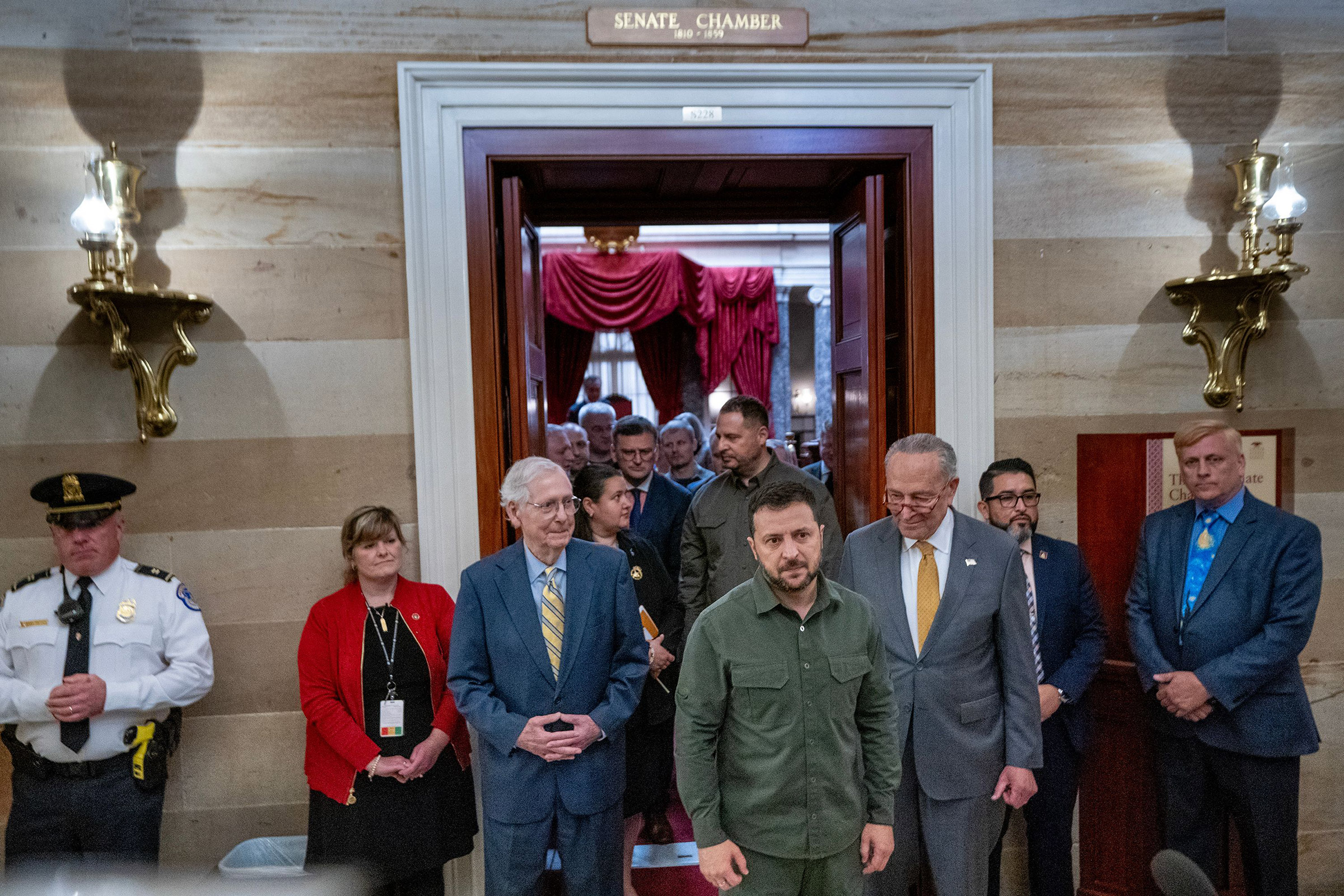
Zelensky leaves a contentious meeting with U.S. Senators in the Capitol on Sept. 21.

Volodymyr Zelensky was running late.

The invitation to his speech at the National Archives in Washington had gone out to several hundred guests, including congressional leaders and top officials from the Biden Administration. Billed as the main event of his visit in late September, it would give him a chance to inspire U.S. support against Russia with the kind of oratory the world has come to expect from Ukraine’s wartime President. It did not go as planned.

[time-brightcove not-tgx=”true”]

That afternoon, Zelensky’s meetings at the White House and the Pentagon delayed him by more than an hour, and when he finally arrived to begin his speech at 6:41 p.m., he looked distant and agitated. He relied on his wife, First Lady Olena Zelenska, to carry his message of resilience on the stage beside him, while his own delivery felt stilted, as though he wanted to get it over with. At one point, while handing out medals after the speech, he urged the organizer to hurry things along. 

The reason, he later said, was the exhaustion he felt that night, not only from the demands of leadership during the war but also the persistent need to convince his allies that, with their help, Ukraine can win. “Nobody believes in our victory like I do. Nobody,” Zelensky told TIME in an interview after his trip. Instilling that belief in his allies, he said, “takes all your power, your energy. You understand? It takes so much of everything.”

Volodymyr Zelensky Time Magazine cover

It is only getting harder. Twenty months into the war, about a fifth of Ukraine’s territory remains under Russian occupation. Tens of thousands of soldiers and civilians have been killed, and Zelensky can feel during his travels that global interest in the war has slackened. So has the level of international support. “The scariest thing is that part of the world got used to the war in Ukraine,” he says. “Exhaustion with the war rolls along like a wave. You see it in the United States, in Europe. And we see that as soon as they start to get a little tired, it becomes like a show to them: ‘I can’t watch this rerun for the 10th time.’”

Public support for aid to Ukraine has been in decline for months in the U.S., and Zelensky’s visit did nothing to revive it. Some 41% of Americans want Congress to provide more weapons to Kyiv, down from 65% in June, when Ukraine began a major counteroffensive, according to a Reuters survey taken shortly after Zelensky’s departure. That offensive has proceeded at an excruciating pace and with enormous losses, making it ever more difficult for Zelensky to convince partners that victory is around the corner. With the outbreak of war in Israel, even keeping the world’s attention on Ukraine has become a major challenge.

After his visit to Washington, TIME followed the President and his team back to Kyiv, hoping to understand how they would react to the signals they had received, especially the insistent calls for Zelensky to fight corruption inside his own government, and the fading enthusiasm for a war with no end in sight. On my first day in Kyiv, I asked one member of his circle how the President was feeling. The response came without a second’s hesitation: “Angry.”

The usual sparkle of his optimism, his sense of humor, his tendency to liven up a meeting in the war room with a bit of banter or a bawdy joke, none of that has survived into the second year of all-out war. “Now he walks in, gets the updates, gives the orders, and walks out,” says one longtime member of his team. Another tells me that, most of all, Zelensky feels betrayed by his Western allies. They have left him without the means to win the war, only the means to survive it.

But his convictions haven’t changed. Despite the recent setbacks on the battlefield, he does not intend to give up fighting or to sue for any kind of peace. On the contrary, his belief in Ukraine’s ultimate victory over Russia has hardened into a form that worries some of his advisers. It is immovable, verging on the messianic. “He deludes himself,” one of his closest aides tells me in frustration. “We’re out of options. We’re not winning. But try telling him that.”

Zelensky’s stubbornness, some of his aides say, has hurt their team’s efforts to come up with a new strategy, a new message. As they have debated the future of the war, one issue has remained taboo: the possibility of negotiating a peace deal with the Russians. Judging by recent surveys, most Ukrainians would reject such a move, especially if it entailed the loss of any occupied territory.

Zelensky remains dead set against even a temporary truce. “For us it would mean leaving this wound open for future generations,” the President tells me. “Maybe it will calm some people down inside our country, and outside, at least those who want to wrap things up at any price. But for me, that’s a problem, because we are left with this explosive force. We only delay its detonation.” 

For now, he is intent on winning the war on Ukrainian terms, and he is shifting tactics to achieve that. Aware that the flow of Western arms could dry up over time, the Ukrainians have ramped up production of drones and missiles, which they have used to attack Russian supply routes, command centers, and ammunition depots far behind enemy lines. The Russians have responded with more bombing raids against civilians, more missile strikes against the infrastructure that Ukraine will need to heat homes and keep the lights on through the winter.

Zelensky describes it as a war of wills, and he fears that if the Russians are not stopped in Ukraine, the fighting will spread beyond its borders. “I’ve long lived with this fear,” he says. “A third world war could start in Ukraine, continue in Israel, and move on from there to Asia, and then explode somewhere else.” That was his message in Washington: Help Ukraine stop the war before it spreads, and before it’s too late. He worries his audience has stopped paying attention. 
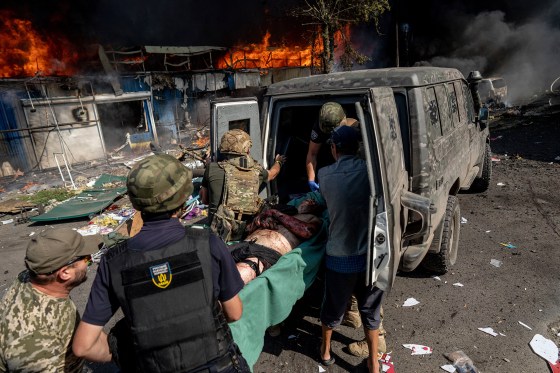
Paramedics help a wounded man after a Russian rocket attack in the eastern Ukrainian city of Kostiantynivka on Sept. 6, 2023.

At the end of last year, during his previous visit to Washington, Zelensky received a hero’s welcome. The White House sent a U.S. Air Force jet to pick him up in eastern Poland a few days before Christmas and, with an escort from a NATO spy plane and an F-15 Eagle fighter, deliver him to Joint Base Andrews outside the U.S. capital. That evening, Zelensky appeared before a joint session of Congress to declare that Ukraine had defeated Russia “in the battle for minds of the world.”

Watching his speech from the balcony, I counted 13 standing ovations before I stopped keeping track. One Senator told me he could not remember a time in his three decades on Capitol Hill when a foreign leader received such an admiring reception. A few right-wing Republicans refused to stand or applaud for Zelensky, but the votes to support him were bipartisan and overwhelming throughout last year. 

This time around, the atmosphere had changed. Assistance to Ukraine had become a sticking point in the debate over the federal budget. One of Zelensky’s foreign policy advisers urged him to call off the trip in September, warning that the atmosphere was too fraught. Congressional leaders declined to let Zelensky deliver a public address on Capitol Hill. His aides tried to arrange an in-person appearance for him on Fox News and an interview with Oprah Winfrey. Neither one came through.

Instead, on the morning of Sept. 21, Zelensky met in private with then House Speaker Kevin McCarthy before making his way to the Old Senate Chamber, where lawmakers grilled him behind closed doors. Most of Zelensky’s usual critics stayed silent in the session; Senator Ted Cruz strolled in more than 20 minutes late. The Democrats, for their part, wanted to understand where the war was headed, and how badly Ukraine needed U.S. support. “They asked me straight up: If we don’t give you the aid, what happens?” Zelensky recalls. “What happens is we will lose.”

Zelensky’s performance left a deep impression on some of the lawmakers present. Angus King, an independent Senator from Maine, recalled the Ukrainian leader telling his audience, “You’re giving money. We’re giving our lives.” But it was not enough. Ten days later, Congress passed a bill to temporarily avert a government shutdown. It included no assistance for Ukraine.

Read More: Inside the Race to Arm Ukraine Before Its Counteroffensive

By the time Zelensky returned to Kyiv, the cold of early fall had taken hold, and his aides rushed to prepare for the second winter of the invasion. Russian attacks on Ukrainian infrastructure have damaged power stations and parts of the electricity grid, leaving it potentially unable to meet spikes in demand when the temperature drops. Three of the senior officials in charge of dealing with this problem told me blackouts would likely be more severe this winter, and the public reaction in Ukraine would not be as forgiving. “Last year people blamed the Russians,” one of them says. “This time they’ll blame us for not doing enough to prepare.”

The cold will also make military advances more difficult, locking down the front lines at least until the spring. But Zelensky has refused to accept that. “Freezing the war, to me, means losing it,” he says. Before the winter sets in, his aides warned me to expect major changes in their military strategy and a major shake-up in the President’s team. At least one minister would need to be fired, along with a senior general in charge of the counteroffensive, they said, to ensure accountability for Ukraine’s slow progress at the front. “We’re not moving forward,” says one of Zelensky’s close aides. Some front-line commanders, he continues, have begun refusing orders to advance, even when they came directly from the office of the President. “They just want to sit in the trenches and hold the line,” he says. “But we can’t win a war that way.”

When I raised these claims with a senior military officer, he said that some commanders have little choice in second-guessing orders from the top. At one point in early October, he said, the political leadership in Kyiv demanded an operation to “retake” the city of Horlivka, a strategic outpost in eastern Ukraine that the Russians have held and fiercely defended for nearly a decade. The answer came back in the form of a question: With what? “They don’t have the men or the weapons,” says the officer. “Where are the weapons? Where is the artillery? Where are the new recruits?”

In some branches of the military, the shortage of personnel has become even more dire than the deficit in arms and ammunition. One of Zelensky’s close aides tells me that even if the U.S. and its allies come through with all the weapons they have pledged, “we don’t have the men to use them.” 
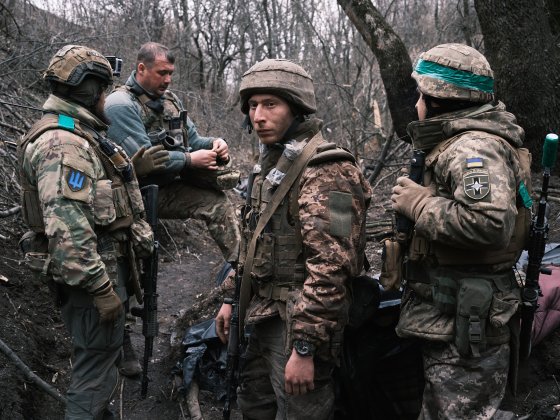
Ukrainian fighters on the frontlines near Bakhmut on March 17, 2023.

Since the start of the invasion, Ukraine has refused to release official counts of dead and wounded. But according to U.S. and European estimates, the toll has long surpassed 100,000 on each side of the war. It has eroded the ranks of Ukraine’s armed forces so badly that draft offices have been forced to call up ever older personnel, raising the average age of a soldier in Ukraine to around 43 years. “They’re grown men now, and they aren’t that healthy to begin with,” says the close aide to Zelensky. “This is Ukraine. Not Scandinavia.”

The picture looked different at the outset of the invasion. One branch of the military, known as the Territorial Defense Forces, reported accepting 100,000 new recruits in the first 10 days of all-out war. The mass mobilization was fueled in part by the optimistic predictions of some senior officials that the war would be won in months if not weeks. “Many people thought they could sign up for a quick tour and take part in a heroic victory,” says the second member of the President’s team.

Now recruitment is way down. As conscription efforts have intensified around the country, stories are spreading on social media of draft officers pulling men off trains and buses and sending them to the front. Those with means sometimes bribe their way out of service, often by paying for a medical exemption. Such episodes of corruption within the recruitment system became so widespread by the end of the summer that on Aug. 11 Zelensky fired the heads of the draft offices in every region of the country. 

The decision was intended to signal his commitment to fighting graft. But the move backfired, according to the senior military officer, as recruitment nearly ground to a halt without leadership. The fired officials also proved difficult to replace, in part because the reputation of the draft offices had been tainted. “Who wants that job?” the officer asks. “It’s like putting a sign on your back that says: corrupt.” 

In recent months, the issue of corruption has strained Zelensky’s relationship with many of his allies. Ahead of his visit to Washington, the White House prepared a list of anti-corruption reforms for the Ukrainians to undertake. One of the aides who traveled with Zelensky to the U.S. told me these proposals targeted the very top of the state hierarchy. “These were not suggestions,” says another presidential adviser. “These were conditions.”

To address the American concerns, Zelensky took some dramatic steps. In early September, he fired his Minister of Defense, Oleksiy Reznikov, a member of his inner circle who had come under scrutiny over corruption in his ministry. Two presidential advisers told me he had not been personally involved in graft. “But he failed to keep order within his ministry,” one says, pointing to the inflated prices the ministry paid for supplies, such as winter coats for soldiers and eggs to keep them fed.

As news of these scandals spread, the President gave strict orders for his staff to avoid the slightest perception of self-enrichment. “Don’t buy anything. Don’t take any vacations. Just sit at your desk, be quiet, and work,” one staffer says in characterizing these directives. Some midlevel officials in the administration complained to me of bureaucratic paralysis and low morale as the scrutiny of their work intensified. 

The typical salary in the President’s office, they said, comes to about $1,000 per month, or around $1,500 for more senior officials, far less than they could make in the private sector. “We sleep in rooms that are 2 by 3 meters,” about the size of a prison cell, says Andriy Yermak, the presidential chief of staff, referring to the bunker that Zelensky and a few of his confidants have called home since the start of the invasion. “We’re not out here living the high life,” he tells me in his office. “All day, every day, we are busy fighting this war.”

Amid all the pressure to root out corruption, I assumed, perhaps naively, that officials in Ukraine would think twice before taking a bribe or pocketing state funds. But when I made this point to a top presidential adviser in early October, he asked me to turn off my audio recorder so he could speak more freely. “Simon, you’re mistaken,” he says. “People are stealing like there’s no tomorrow.” 

Even the firing of the Defense Minister did not make officials “feel any fear,” he adds, because the purge took too long to materialize. The President was warned in February that corruption had grown rife inside the ministry, but he dithered for more than six months, giving his allies multiple chances to deal with the problems quietly or explain them away. By the time he acted ahead of his U.S. visit, “it was too late,” says another senior presidential adviser. Ukraine’s Western allies were already aware of the scandal by then. Soldiers at the front had begun making off-color jokes about “Reznikov’s eggs,” a new metaphor for corruption. “The reputational damage was done,” says the adviser. 

When I asked Zelensky about the problem, he acknowledged its gravity and the threat it poses to Ukraine’s morale and its relationships with foreign partners. Fighting corruption, he assured me, is among his top priorities. He also suggested that some foreign allies have an incentive to exaggerate the problem, because it gives them an excuse to cut off financial support. “It’s not right,” he says, “for them to cover up their failure to help Ukraine by tossing out these accusations.” 

U.S. President Joe Biden, right, welcomes Ukrainian President Volodymyr Zelensky at the South Portico of the White House on Sept. 21, 2023.

But some of the accusations have been hard to deny. In August, a Ukrainian news outlet known for investigating graft, Bihus.info, published a damning report about Zelensky’s top adviser on economic and energy policy, Rostyslav Shurma. The report revealed that Shurma, a former executive in the energy industry, has a brother who co-owns two solar-energy companies with power plants in southern Ukraine. Even after the Russians occupied that part of the country, cutting it off from the Ukrainian power grid, the companies continued to receive state payments for producing electricity.

Read More: Inside the Kremlin’s Year of Ukraine Propaganda.

The anticorruption police, an independent agency known in Ukraine as NABU, responded to the publication by opening an embezzlement probe into Shurma and his brother. But Zelensky did not suspend his adviser. Instead, in late September, Shurma joined the President’s delegation to Washington, where I saw him glad-handing senior lawmakers and officials from the Biden Administration.

Soon after he returned to Kyiv, I visited Shurma in his office on the second floor of the presidential headquarters. The atmosphere inside the compound had changed in the 11 months since my last visit. Sandbags had been removed from many windows as new air-defense systems had arrived in Kyiv, including U.S. Patriot missiles, which reduced the risk of a rocket attack on Zelensky’s office. The hallways remained dark, but soldiers no longer patrolled them with assault rifles, and their sleeping mats and other gear had been cleared away. Some of the President’s aides, including Shurma, had gone back to wearing civilian clothes instead of military garb.

When we sat down inside his office, Shurma told me the allegations against him were part of a political attack paid for by one of Zelensky’s domestic enemies. “A piece of sh-t was thrown,” he says, brushing the front of his starched white shirt. “And now we have to explain that we are clean.” It did not seem to trouble him that his brother is a major player in the industry that Shurma oversees. On the contrary, he spent nearly half an hour trying to convince me of the gold rush that renewable energy would see after the war.

Perhaps, I suggested, amid all the concerns about corruption in Ukraine, it would have been wiser for Shurma to step aside while under investigation for embezzlement, or at least sit out Zelensky’s trip to Washington. He responded with a shrug. “If we do that, tomorrow everybody on the team would be targeted,” he says. “Politics is back, and that’s the problem.”

A few minutes later, Shurma’s phone lit up with an urgent message that forced him to cut our interview short. The President had called his senior aides into a meeting in his office. It was normal on Monday mornings for their team to hold a strategy session to plan out the week. But this one would be different. Over the weekend, Palestinian terrorists had massacred many hundreds of civilians in southern Israel, prompting the Israeli government to impose a blockade of the Gaza Strip and declare war against Hamas. Huddled around a conference table, Zelensky and his aides tried to understand what the tragedy would mean for them. “My mind is racing,” one of them told me when he emerged from the meeting that afternoon. “Things are about to start moving very fast.”

From the earliest days of the Russian invasion, Zelensky’s top priority and perhaps his main contribution to the nation’s defense had been to keep attention on Ukraine and to rally the democratic world to its cause. Both tasks would become a lot harder with the outbreak of war in Israel. The focus of Ukraine’s allies in the U.S. and Europe, and of the global media, quickly shifted to the Gaza Strip.

“It’s logical,” Zelensky tells me. “Of course we lose out from the events in the Middle East. People are dying, and the world’s help is needed there to save lives, to save humanity.” Zelensky wanted to help. After the crisis meeting with aides, he asked the Israeli government for permission to visit their country in a show of solidarity. The answer appeared the following week in Israeli media reports: “The time is not right.” 

A few days later, President Biden tried to break through the impasse Zelensky had seen on Capitol Hill. Instead of asking Congress to vote on another stand-alone package of Ukraine aid, Biden bundled it with other priorities, including support for Israel and U.S.-Mexico border security. The package would cost $105 billion, with $61 billion of it for Ukraine. “It’s a smart investment,” Biden said, “that’s going to pay dividends for American security for generations.”

But it was also an acknowledgment that, on its own, Ukraine aid no longer stands much of a chance in Washington. When I asked Zelensky about this, he admitted that Biden’s hands appear to be tied by GOP opposition. The White House, he said, remains committed to helping Ukraine. But arguments about shared values no longer have much sway over American politicians or the people who elect them. “Politics is like that,” he tells me with a tired smile. “They weigh their own interests.” 

At the start of the Russian invasion, Zelensky’s mission was to maintain the sympathy of humankind. Now his task is more complicated. In his foreign trips and presidential phone calls, he needs to convince world leaders that helping Ukraine is in their own national interests, that it will, as Biden put it, “pay dividends.” Achieving that gets harder as global crises multiply. 

But faced with the alternative of freezing the war or losing it, Zelensky sees no option but to press on through the winter and beyond. “I don’t think Ukraine can allow itself to get tired of war,” he says. “Even if someone gets tired on the inside, a lot of us don’t admit it.” The President least of all. —With reporting by Julia Zorthian/New York


from TIME https://ift.tt/oVBf5GH

Fleeing Despair, More Chinese Migrants Are Journeying to the U.S. Border to Seek Asylum

Immigration China

SAN DIEGO — The young Chinese man looked lost and exhausted when Border Patrol agents left him at a transit station. Deng Guangsen, 28, had spent the last two months traveling to San Diego from the southern Chinese province of Guangdong, through seven countries on plane, bus and foot, including traversing Panama’s dangerous Darién Gap jungle.

“I feel nothing,” Deng said in the San Diego parking lot, insisting on using the broken English he learned from the “Harry Potter” film series. “I have no brother, no sister. I have nobody.”

[time-brightcove not-tgx=”true”]

Deng is part of a major influx of Chinese migration to the United States on a relatively new and perilous route that has become increasingly popular with the help of social media. Chinese people were the fourth-highest nationality, after Venezuelans, Ecuadorians, and Haitians, crossing the Darién Gap during the first nine months of this year, according to Panamanian immigration authorities.

Chinese asylum-seekers who spoke to The Associated Press, as well as observers, say they are seeking to escape an increasingly repressive political climate and bleak economic prospects.

They also reflect a broader presence of migrants at the U.S.-Mexico border — Asians, South Americans, and Africans — who made September the second-highest month of illegal crossings and the U.S. government’s 2023 budget year the second-highest on record.

The pandemic and China’s COVID-19 policies, which included tight border controls, temporarily stemmed the exodus that rose dramatically in 2018 when President Xi Jinping amended the constitution to scrap the presidential term limit. Now emigration has resumed, with China’s economy struggling to rebound and youth unemployment high. The United Nations has projected China will lose 310,000 people through emigration this year, compared with 120,000 in 2012.

Read More: China’s Aging Population Is a Major Concern. But Its Youth May Be an Even Bigger Problem

It has become known as “runxue,” or the study of running away. The term started as a way to get around censorship, using a Chinese character whose pronunciation spells like the English word “run” but means “moistening.” Now it’s an internet meme.

“This wave of emigration reflects despair toward China,” Cai Xia, editor-in-chief of the online commentary site of Yibao and a former professor at the Central Party School of the Chinese Communist Party in Beijing.

“They’ve lost hope for the future of the country,” said Cai, who now lives in the U.S. “You see among them the educated and the uneducated, white-collar workers, as well as small business owners, and those from well-off families.”

Those who can’t get a visa are finding other ways to flee the world’s most populous nation. Many are showing up at the U.S.-Mexico border to seek asylum. The Border Patrol made 22,187 arrests of Chinese for crossing the border illegally from Mexico from January through September, nearly 13 times the same period in 2022. Arrests peaked at 4,010 in September, up 70% from August. The vast majority were single adults.

The popular route to the U.S. is through Ecuador, which has no visa requirements for Chinese nationals. Migrants from China join Latin Americans there to trek north through the once-impenetrable Darién and across several Central American countries before reaching the U.S. border. The journey is well-known enough it has its own name in Chinese: walk the line, or “zouxian.”

Read More: How Panama Became the Most Treacherous Crossing Point for Migrants on a Long Journey to the U.S.

The monthly number of Chinese migrants crossing the Darién has been rising gradually, from 913 in January to 2,588 in September. For the first nine months of this year, Panamanian immigration authorities registered 15,567 Chinese citizens crossing the Darién. By comparison, 2,005 Chinese people trekked through the rainforest in 2022, and just 376 in total from 2010 to 2021.

Short video platforms and messaging apps provide not only on-the-ground video clips but also step-by-step guides from China to the U.S., including tips on what to pack, where to find guides, how to survive the jungle, which hotels to stay at, how much to bribe police in different countries and what to do when encountering U.S. immigration officers.

Translation apps allow migrants to navigate through Central America on their own, even if they don’t speak Spanish or English. The journey can cost thousands to tens of thousands of dollars, paid for with family savings or even online loans.

It’s markedly different from the days when Chinese nationals paid smugglers, known as snakeheads, and traveled in groups.

With more financial resources, Xi Yan, 46, and her daughter Song Siming, 24, didn’t trek the Ecuador-Mexico route, but instead flew into Mexico via Europe. With help from a local guide, the two women crossed the border at Mexicali into the U.S. in April.

“The unemployment rate is very high. People cannot find work,” said Xi Yan, a Chinese writer. “For small business owners, they cannot sustain their businesses.”

Read More: China’s Solution to Inequality? Cracking Down on Displays of Wealth and Poverty

Xi Yan said she decided to leave China in March, when she traveled to the southern city of Foshan to see her mother but had to leave the next day when state security agents and police officers harassed her brother and told him that his sister was not allowed in the city. She realized she was still on the state blacklist, six years after being detained for gathering at a seaside spot to remember Liu Xiaobo, a Nobel peace laureate who died in a Chinese prison. In 2015, she was locked up for 25 days over an online post remembering the victims of the 1989 Tiananmen Massacre.

Her daughter, Song, agreed to leave with her. A college graduate, the daughter struggled to find work in China and became depressed, the mother said.

Despite the challenges to survive in the U.S., Xi Yan said it was worth it.

“We have freedom,” she said. “I used to get nervous whenever there was a police car. Now, I don’t have to worry about it anymore.”

Migrants hoping to enter the U.S. at San Diego wait for agents to pick them up in an area between two border walls or in remote mountains east of the city covered with shrubs and large boulders.

Many migrants are released with court dates in cities nearest their final destination in a bottlenecked system that takes years to decide cases. Chinese migrants had an asylum grant rate of 33% in the 2022 budget year, compared with 46% for all nationalities, according to Syracuse University’s Transactional Records Access Clearinghouse.

Read More: Tens of Thousands Seek Asylum in the U.S. Who Gets to Stay?

Catholic Charities of San Diego uses hotels to provide shelters for migrants, including 1,223 from China in September. The average shelter stay is a day and a half among all nationalities. For Chinese visitors, it’s less than a day.

“They get dropped off in the morning. By afternoon they are looking to reunite with their families. They’re going to New York, they’re going to Chicago, they’re going to all kinds of places,” said Vino Pajanor, the group’s chief executive. “They don’t want to be in a shelter.”

In September, 98% of U.S. border arrests of Chinese people occurred in the San Diego area. At the transit stop, migrants charge phones, snack, browse piles of free clothing, and get travel advice.

Signs at portable bathrooms and information booths and a volunteer’s loudspeaker announcements about free airport shuttles are translated to multiple languages, including Mandarin. Taxi drivers offer rides to Los Angeles.

Many migrants who spoke to the AP did not give their full names out of fear of drawing attention to their cases. Some said they came for economic reasons and paid 300,000 to 400,000 yuan ($41,000 to $56,000 for the trip).

In recent weeks, Chinese migrants have filled makeshift encampments in the California desert as they wait to turn themselves in to U.S. authorities to make asylum claims.

Read More: The Overlooked History of Angel Island, Where the U.S. Enforced Rules Designed to Keep Asian Immigrants Out

Near the small town of Jacumba, hundreds huddled in the shadow of a section of border wall and under crude tarps. Others tried to sleep on large boulders or under the few trees there. Small campfires keep them warm overnight. Without food or running water, the migrants rely on volunteers who distribute bottled water, hot oatmeal, and peanut butter and jelly sandwiches.

Chen Yixiao said he endured a hard journey to come to the U.S. He said life had become difficult back home, with some migrants experiencing issues with the government and others failing in business.

“I’m very happy to be in the U.S. now. This is my dream country,” said Chen, who planned to join his relatives in New York and find work there.

At San Diego’s transit station, Deng was headed to Monterey Park, a Los Angeles suburb that became known as “Little Taipei” in the 1980s. But when he didn’t provide the Border Patrol with a U.S. address, an agent scheduled an initial immigration court appearance for him in New York in February.

Deng said he worked a job in Guangdong requiring him to ride motorcycles, which he considered unsafe. As he lingered at the transit station, sitting on a curb with his small backpack, several Africans approached to ask questions. He told them he arrived in the U.S. with $880 in his pockets.

Tang reported from Washington. Associated Press writers Christopher Sherman in Mexico City and Eugene Garcia in San Diego contributed.


from TIME https://ift.tt/mRanPhg

Sunday, October 29, 2023

Russia Says It Shot Down 36 Ukrainian Drones Overnight as Conflict Rages On

Ukraine: Drone Unit Operates in Kurdyumivka Frontline

KYIV, Ukraine — Russian air defense shot down over 30 Ukrainian drones over the Black Sea and the Crimean peninsula overnight Saturday, Russia’s Defense Ministry said Sunday.

“The air defense systems in place destroyed 36 Ukrainian unmanned aerial vehicles over the Black Sea and the northwestern part of the Crimean peninsula,” the ministry wrote on Telegram.

[time-brightcove not-tgx=”true”]

Local authorities in the southern Krasnodar region bordering the Black Sea said that a fire broke out at an oil refinery in the early hours of Sunday, but did not specify the cause. “The reasons for the incident are being established,” a statement from local authorities said, amid claims in local media outlets that the fire had been caused by a drone strike or debris from a downed drone.

Drone strikes and shelling on the Russian border regions and Moscow-annexed Crimea are a regular occurrence. Ukrainian officials never acknowledge responsibility for attacks on Russian territory or the Crimean peninsula.

In Ukraine, the country’s air force said Sunday it had shot down five Iranian-made Shahed exploding drones launched by Russia overnight.

Close to the front line in the country’s east, where Ukrainian and Russian forces are locked in a grinding battle for control, four police officers were wounded when a shell fired by Russian troops exploded by their police car in the city of Siversk, located in the partly occupied Donetsk province.

British intelligence assessed this weekend that Russia had suffered some of its biggest casualty rates so far this year as a result of continued “heavy but inconclusive” fighting around the town of Avdiivka, also in the Donetsk province. The UK Ministry of Defence’s regular intelligence update on Saturday morning noted that Russia had committed “elements of up to eight brigades” in the area since it launched its “major offensive effort” in mid-October.

Also on Sunday, a prominent ally of Russian President Vladimir Putin warned that Russia might take action to seize assets of European Union member states it considers hostile if the EU proceeds with its plan to “steal” frozen Russian funds to support Ukraine’s post-war reconstruction efforts.

“A number of European politicians (…) have once again started talking about stealing our country’s frozen funds in order to continue the militarization of Kyiv,” Vyacheslav Volodin, the Chairman of the State Duma, the lower house of Russia’s parliament, wrote on Telegram.

Volodin made the statement in response to an announcement on Friday by Ursula von der Leyen, the president of the European Commission, on a proposal to use earnings from frozen Russian state assets to support Ukraine in its rebuilding.

Volodin asserted that Moscow would respond with measures that would inflict significant costs on the EU if it were to take action against Russian assets, a considerable portion of which are in Belgium.

“Such a decision would require a symmetrical response from the Russian Federation. In that case, far more assets belonging to unfriendly countries will be confiscated than our frozen funds in Europe,” Volodin said.


from TIME https://ift.tt/rVq6spi

Palestinian Death Toll Passes 8,000 as U.N. Aid Warehouses Suffer Break-Ins

Israel-Palestinians-Conflict

DEIR AL-BALAH, Gaza Strip — Thousands of people broke into aid warehouses in Gaza to take flour and basic hygiene products, a U.N. agency said Sunday, in a mark of growing desperation and the breakdown of public order three weeks into the war between Israel and Gaza’s militant Hamas rulers.

Tanks and infantry pushed into Gaza over the weekend as Israeli Prime Minister Benjamin Netanyahu announced a “second stage” in the war, which was ignited by Hamas’ brutal Oct. 7 incursion into Israel. Israel also pounded the territory from air, land and sea.

[time-brightcove not-tgx=”true”]

Gaza’s Health Ministry said the death toll among Palestinians has passed 8,000 — mostly women and minors. It’s a toll without precedent in decades of Israeli-Palestinian violence, and it is expected to climb even more rapidly as Israel presses its ground offensive. Over 1,400 people have died on the Israeli side, mainly civilians killed during the initial Hamas onslaught.

Communications were restored to much of Gaza early Sunday after a bombardment described by Gaza residents as the most intense of the war knocked out most contact with the territory late Friday. The besieged enclave’s 2.3 million people were largely cut off from the world.

The Israeli military said Sunday it had struck over 450 militant targets over the past 24 hours, including Hamas command centers and anti-tank missile launching positions. It said more ground forces were sent into Gaza overnight, and officials circulated footage showing tanks and troops operating in open areas.

The warehouse break-ins were “a worrying sign that civil order is starting to break down after three weeks of war and a tight siege on Gaza,” said Thomas White, Gaza director for the U.N. agency for Palestinian refugees, known as UNRWA. “People are scared, frustrated and desperate.”

UNRWA provides basic services to hundreds of thousands of people in Gaza. Its schools across the territory have been transformed into packed shelters housing Palestinians displaced by the conflict. Israel has allowed only a small trickle of aid to enter from Egypt, some of which was stored in one of the warehouses that was broken into, UNRWA said.

Juliette Touma, a spokesperson for the agency, said the crowds broke into four facilities on Saturday. She said the warehouses did not contain any fuel, which has been in critically short supply since Israel cut off all shipments after the start of the war.

Israeli authorities said Sunday that they would soon allow more humanitarian aid to enter Gaza, though details remained unclear.

Elad Goren, the head of civil affairs of COGAT, the Israeli defense body responsible for Palestinian civilian affairs, said Israel had established a “humanitarian zone” near the southern city of Khan Younis and recommended that Palestinians flee there.

But he provided no details on the exact location of the zone or how much aid would be available. He also said Israel has opened two water lines in southern Gaza within the past week. The AP could not independently verify that either line was functioning.

Meanwhile, residents living near Shifa Hospital, Gaza’s largest, said Israeli airstrikes overnight hit near the hospital complex and blocked many roads leading to it. Israel accuses Hamas of having a secret command post beneath the hospital but has not provided much evidence. Hamas denies the allegations.

Tens of thousands of civilians are sheltering in Shifa, which is also packed with wounded patients.

“Reaching the hospital has become increasingly difficult,” Mahmoud al-Sawah, who is sheltering in the hospital, said over the phone. “It seems they want to cut off the area.” Another Gaza City resident, Abdallah Sayed, said the Israeli bombing over the past two days was “the most violent and intense” since the war started.

The Palestinian Red Crescent rescue service said another Gaza City hospital received two calls from Israeli authorities on Sunday ordering it to evacuate. It said airstrikes have hit as close as 50 meters (yards) from the Al-Quds Hospital, where 12,000 people are sheltering.

Israel ordered the hospital to evacuate more than a week ago, but it and other medical facilities have refused, saying evacuation would mean death for patients on ventilators.

“We reiterate — it’s impossible to evacuate hospitals full of patients without endangering their lives,” World Health Organization Director-General Tedros Adhanom Ghebreyesus said on social media.

There was no immediate Israeli comment on the latest evacuation order or the strikes near Shifa.

Israel says most residents have heeded its orders to flee to the southern part of the besieged territory, but hundreds of thousands remain in the north, in part because Israel has also bombarded targets in so-called safe zones.

An Israeli airstrike hit a two-story house in Khan Younis on Sunday, killing at least 13 people, including 10 from one family. The bodies were brought to the nearby Nasser Hospital, according to an Associated Press journalist at the scene.

The escalation has ratcheted up domestic pressure on Israel’s government to secure the release of some 230 hostages seized when Hamas fighters from Gaza breached Israel’s defenses and stormed into nearby towns, gunning down civilians and soldiers in a surprise attack.

Desperate family members met with Netanyahu on Saturday and expressed support for an exchange for Palestinian prisoners held in Israel.

Hamas says it is ready to release all hostages if Israel releases all of the thousands of Palestinians held in its prisons. Israel has dismissed the offer.

Netanyahu said Saturday that Israel is determined to bring back all the hostages, and that the expanding ground operation “will help us in this mission.”

“This is the second stage of the war, whose objectives are clear: to destroy the military and governmental capabilities of Hamas and bring the hostages home,” he said in a televised address.

The Israeli military said it was gradually expanding its ground operations inside Gaza, while stopping short of calling it an all-out invasion. Casualties on both sides are expected to rise sharply as Israeli forces and Palestinian militants battle in dense residential areas.

When asked about Israel’s military escalation, President Joe Biden’s national security adviser, Jake Sullivan, told ABC’s “This Week”: “Ultimately, these are their decisions. This is their action, and they’re best postured to be able to answer questions about how it’s proceeding.” On CBS’ “Face the Nation,” he said the U.S. believes “there should be humanitarian pauses to get hostages out, potentially to get aid in.”

Despite the Israeli offensive, Palestinian militants have continued firing rockets into Israel, with the constant sirens in southern Israel a reminder of the threat.

Israel says its strikes target Hamas fighters and infrastructure and that the militants operate among civilians, putting them in danger. An estimated 1,800 people remain trapped beneath the rubble, according to Gaza’s Health Ministry, which has said it bases its estimates on distress calls it received.

More than 1.4 million people across Gaza have fled their homes, nearly half crowding into U.N. schools and shelters, following repeated warnings by the Israeli military that they would be in danger if they remained in northern Gaza.

Gaza’s sole power plant shut down shortly after the start of the war, and Israel has allowed no fuel to enter, saying Hamas would use it for military purposes.

Hospitals are struggling to keep emergency generators running to operate incubators and other life-saving equipment, and UNRWA is also trying to keep water pumps and bakeries running to meet essential needs.

At Nasser Hospital in Khan Younis, emergency director Dr. Mohammed Qandeel said about 20,000 civilians were sheltering there. “I brought my kids to sleep here,” said one displaced resident who gave her name only as Umm Ahmad. “I used to be afraid of my kids playing in the sand. Now their hands are dirty with the blood on the floor.”


from TIME https://ift.tt/1IYF3b0